Best Home EV Chargers 2026
Our honest shortlist for Orlando homes — what each charger is best at, and how to pick the right one for your car and your panel.
What EV charger should I install at home? It is the question behind every “best EV chargers for home 2026” search, and the honest answer is that there is no single best charger — there is a best charger for your car, your panel and your driving. This guide gives you our shortlist: the five home chargers we install most often in Orlando, what each one is best at, and how to choose between them. We install all of them, with no brand kickbacks — the recommendation at your survey is based on fit, not on commission.
A note on how to read this guide: we describe each charger in general terms — its strengths, its connector, its install style — and we do not publish prices or specifications that change with model revisions. Charger prices and detailed specs change often enough that a printed figure is out of date within months. Your survey quote gives you the current figure for the charger you choose, as one all-inclusive price with the install.
Tesla Wall Connector — best for Tesla drivers
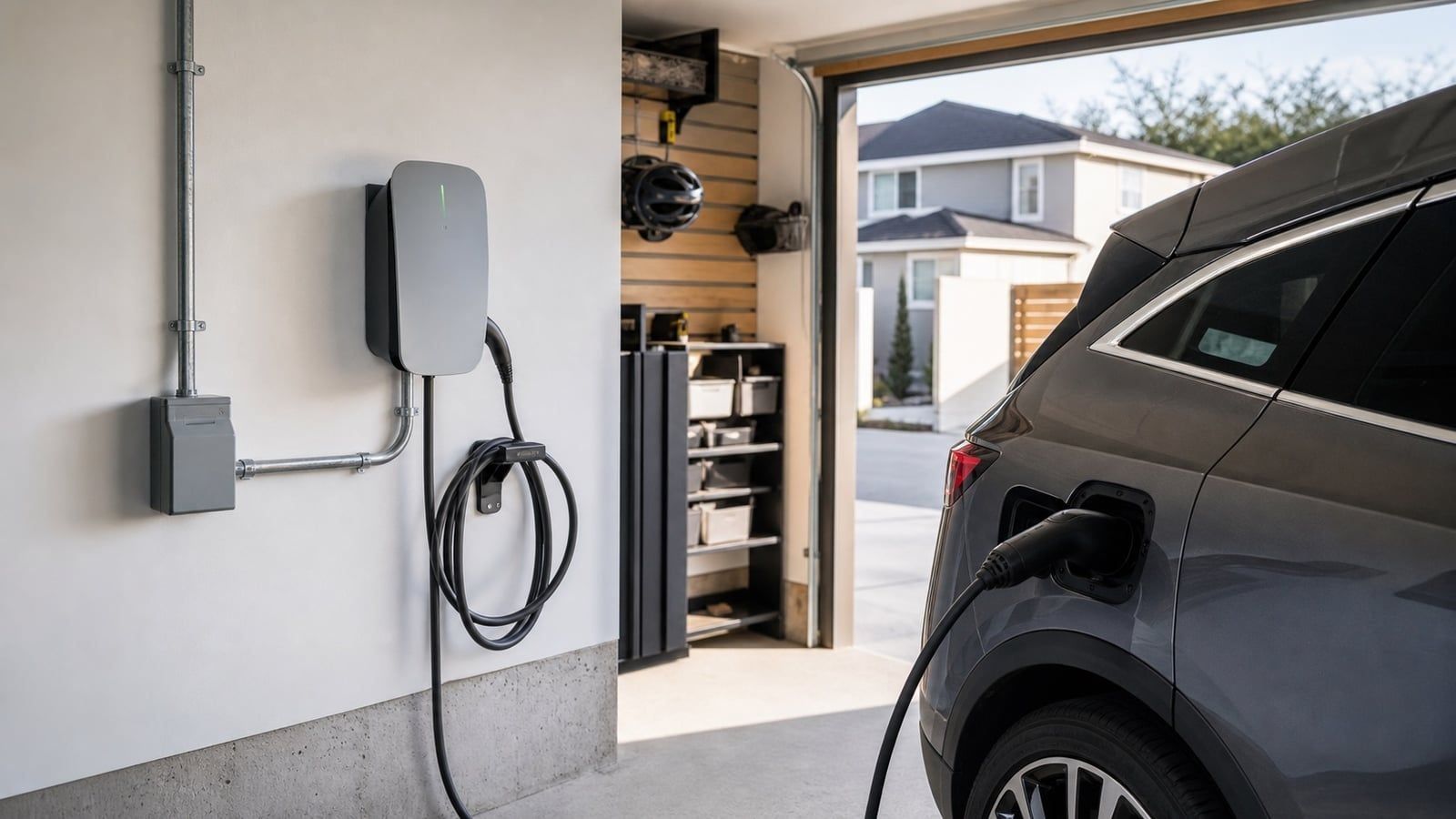
The Tesla Wall Connector is the natural choice for a Tesla household. It is Tesla's hardwired home charger, with a native NACS connector that plugs straight into any Tesla, up to 48A charging on a 60A circuit, an outdoor rating, and power-sharing between two Wall Connectors for a two-Tesla garage. It is clean, well-made, and tightly integrated with the Tesla app experience. If you drive a Tesla and plan to keep driving Teslas, it is the simplest and most capable choice — and it is the charger we install most often in Orlando.
Its limitation is also its strength: it is built for Teslas. A non-Tesla driver needs an adapter, and a household with one Tesla and one non-Tesla may prefer a charger with a J1772 connector. But for a Tesla-only household, the Wall Connector is the benchmark the others are measured against. Our Tesla Wall Connector ownership guide covers it in full, and our Tesla vs ChargePoint comparison pits it against its closest rival.
ChargePoint Home Flex — best all-rounder and app
The ChargePoint Home Flex is the best all-rounder on this list, and the best choice for most non-Tesla households. It is available with a J1772 connector for most non-Tesla cars and with a NACS version for Tesla drivers who want ChargePoint's features, and it can be installed hardwired or as a plug-in on a NEMA 14-50 outlet — the flexibility that makes it easy to fit to almost any home. Its app is widely regarded as one of the best for energy tracking and scheduling, and it connects to the wider ChargePoint public network if you also charge away from home.
The Home Flex is also the charger with the largest troubleshooting footprint — Wi-Fi, blinking lights, firmware and factory resets are common search topics — which is a sign of how many are installed, not of unreliability. Our smart charger Wi-Fi troubleshooting guide covers the common issues in general informational terms. For a household that wants a capable, flexible charger with a strong app, the Home Flex is the default recommendation.
Wallbox, Emporia and Grizzl-E — compact, value and rugged
Wallbox Pulsar Plus is the compact choice: small, neat on the wall, and strong on load sharing, which makes it a good fit for tight garages and two-EV households that want power-sharing without two large units. Emporia is the value choice with energy monitoring built in — a good fit for a driver who wants to see exactly what charging costs and when, and for a household that wants load management without a premium price. Grizzl-E is the rugged, simple choice: a tough, outdoor-capable unit with minimal fuss, popular for driveway and carport installs where weather resistance matters more than app features.
None of these three is the “best” in general, and all three are excellent in their niche. Wallbox suits a compact garage and a load-sharing plan. Emporia suits a budget-conscious household that still wants monitoring. Grizzl-E suits an outdoor install and a driver who wants a charger that simply works, every night, without an app in the way. Your survey is where the niche gets matched to your home: the garage, the panel, the parking and the driving all point to one of them.
What EV charger to install at home? How to choose
What EV charger to install at home depends on four things, in order: your car's connector, your panel, your daily miles, and your install style. Connector first — NACS for a Tesla, J1772 for most non-Teslas — because a native connector beats an adapter every day. Panel second — a 100-amp panel may mean a lower-amperage install or load management, which suits some chargers better than others. Daily miles third — a long commute justifies a faster hardwired install, while a short commute is happy on a plug-in charger. And install style last — hardwired for speed and outdoor use, plug-in for flexibility and moving house.
Which EV charger to install at home is also a question about the future: a second EV, a new car in a few years, a move. A charger with power-sharing, or a plug-in install that travels, is worth more if any of those are likely. Tell your installer about the future, not just the present — the first install is the cheapest time to prepare for it. And remember the install matters as much as the charger: a great charger on an undersized circuit is a bad install, and a modest charger on a correct circuit is a good one.
What the best chargers cost to install
A typical Level 2 home install in Orlando runs $800–$2,500 including the charger, with simple short-run jobs from around $599. The charger choice moves the price by a modest amount; the wire run, the panel and the mounting move it far more. That is why we quote the job as one all-inclusive figure — charger, breaker, wire, labour, permit and inspection — rather than a charger price plus unknowns. If a quote gives you only the charger price, ask for the rest before you commit.
And a final honest note: the “best” charger is the one that is correctly installed on a correctly sized circuit, with a load calculation behind it, a permit, and an inspection. Every charger on this list meets that standard when it is installed properly. Choose by fit, install it properly, and any of the five will serve you for a decade or more.
Questions Homeowners Ask Us
What EV charger should I install at home?
It depends on your car's connector, your panel, your daily miles and whether you want hardwired or plug-in. Tesla drivers usually suit the Wall Connector; non-Tesla drivers usually suit the ChargePoint Home Flex, Wallbox, Emporia or Grizzl-E with J1772.
What are the best EV chargers for home in 2026?
Our shortlist: Tesla Wall Connector for Tesla households, ChargePoint Home Flex as the best all-rounder, Wallbox for compact load-sharing, Emporia for value with energy monitoring, and Grizzl-E for rugged outdoor use.
Which EV charger to install at home for a non-Tesla?
A J1772 charger — ChargePoint Home Flex, Wallbox, Emporia or Grizzl-E — plugs straight into most non-Tesla cars with no adapter. Choose by panel, driving and install style.
Does the charger brand affect the install cost much?
Only modestly. A typical install is $800–$2,500 including the charger; the wire run, panel capacity and mounting move the price far more than the charger brand.
Ready to Get Your Charger Installed?
Every quote starts with a free on-site assessment and load calculation. Call (407) 555-0134 (placeholder) or visit our contact page to book your survey.
Related services: Level 2 EV charger installation, Tesla Wall Connector installation, Residential EV charger installation.
Related guides: Tesla Wall Connector vs ChargePoint, Tesla Wall Connector ownership guide, First EV home charging beginners guide.
Service areas: Lake Nona, Oviedo — and all areas on our service areas page. Back to the EV charger guides hub.