Vehicle-to-Home (V2H) Backup Power: Florida Guide
Vehicle to home EV backup power Florida is the idea that your electric car — a battery on wheels, often holding far more energy than a home battery — can keep your lights, fridge and Wi-Fi running when the grid goes down. In a state where hurricanes and summer storms cut power, that is a powerful idea. This guide explains what V2H can and cannot do, which vehicles support it, what the install involves, and how it compares with a generator or a home battery.
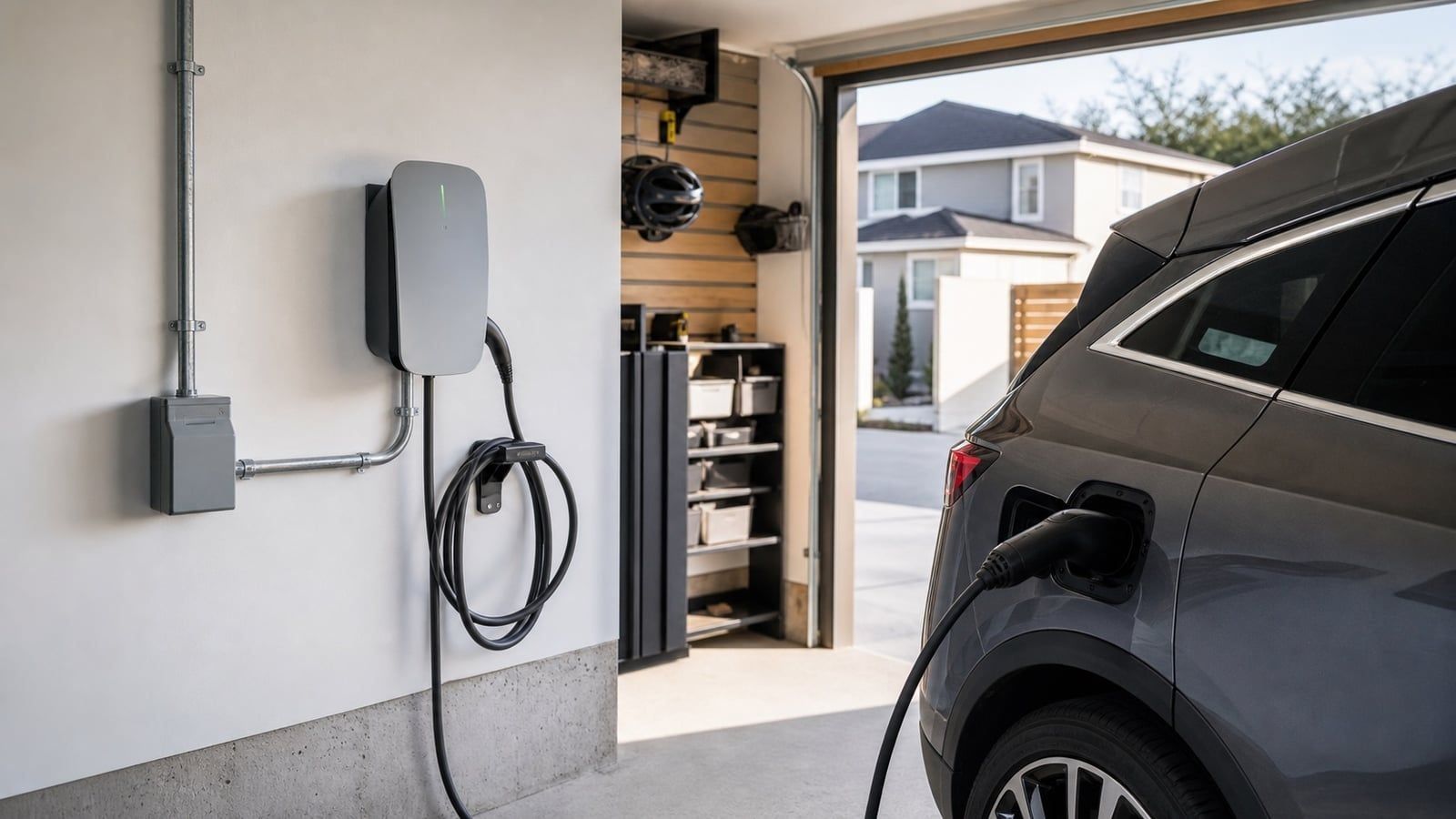
Which Vehicles Can Do V2H?
What Can V2H Actually Run?
V2L vs V2H vs V2G: Three Different Things
| Mode | What it does | Typical power |
|---|---|---|
| V2L — vehicle-to-load | Powers individual devices from the car's built-in outlets | About 3.6 kW, up to 9.6 kW of onboard outlets on some trucks |
| V2H — vehicle-to-home | Powers circuits in your home through a transfer system | About 9.6–12 kW, depending on the vehicle and system |
| V2G — vehicle-to-grid | Exports power back to the grid | Needs utility interconnection approval and a bidirectional meter; still rare in the US |
V2L is the simplest: plug a fridge, a fan or a phone charger into the car and it runs, no home wiring involved. V2H is the step up: the car powers chosen circuits in the house — lights, fridge, Wi-Fi, medical devices — through a transfer switch or gateway wired into the panel. V2G is a different category altogether, because exporting to the grid needs the utility's approval and a bidirectional meter, and it is still rare in the United States. Most Florida homeowners asking about backup power mean V2H, not V2G, and that is what this guide covers.
How Power Gets Into the Panel: Three Ways
There are three ways V2H power enters your home's panel. An interlock kit is the simplest: a mechanical device on the panel that prevents the main breaker and the backup breaker from being on at the same time, so the car can never back-feed the grid. A manual transfer switch is the next step: you switch chosen circuits from grid power to car power by hand when the outage starts. An automatic gateway is the most complete: it detects the outage, isolates the home from the grid, and brings the backed-up circuits onto car power without you touching anything — and switches back when the grid returns.
Which one fits depends on the vehicle system, the panel and the budget. The automatic gateway is the most convenient and the most expensive; the interlock kit is the cheapest and needs you to be home and to act. All three must be installed by a licensed electrician, to code, with the right listing.
Listing, Code and the Utility
V2H equipment must be listed to UL 9741, the standard for EV power export equipment. The install follows NEC Article 625 for EV power transfer, Article 702 for optional standby systems, and Article 705 for interconnected sources. A permit and an inspection are required, as with any work that changes how power enters the panel.
The utility territory matters too. Orlando Utilities Commission serves the City of Orlando and some surrounding areas, including St. Cloud; Duke Energy Florida serves much of the rest of Orange County and beyond. A backup-only V2H system, which never exports to the grid, is a simpler conversation with either utility than a V2G system, which needs interconnection approval and a bidirectional meter. If you only want backup power — and most homeowners do — say so clearly, and design the system as backup-only.
V2H vs Generator vs Home Battery
| Option | Strengths | Limits |
|---|---|---|
| V2H | Large battery you already own; quiet; no fuel | Only some vehicles; car must be home and charged; AC is hard |
| Standby generator | Runs the whole home, including AC; works in any outage | Fuel, noise, maintenance, installation cost |
| Home battery | Automatic; pairs with solar; silent | Smaller capacity than an EV; cost per kilowatt-hour is high |
There is no single right answer. A generator suits a home that must keep air conditioning running. A home battery suits a solar home that wants automatic backup. V2H suits a household that already owns a compatible truck or SUV and wants days of essentials from a battery it already paid for. Some homes combine them — V2H for essentials, a generator for the air conditioner — and that combination is worth discussing at the survey.
The Bottom Line
V2H is real, it works, and for the right vehicle it is the most capable backup most Florida homeowners will ever own. It is not universal — your vehicle, your panel and your backed-up loads all have to line up — and it is not a substitute for a generator if air conditioning is non-negotiable. Start with the vehicle: confirm it supports V2H, confirm the matched equipment, then get a site survey for the panel and the transfer system.
Orlando EV Installers are licensed and insured Florida electricians, and we handle permits and inspection on every job, with a load calculation first. Call (407) 555-0134 (placeholder), or see our Level 2 EV charger installation, our residential EV charger installation and our Tesla Wall Connector installation. Related reading: our hurricane preparedness guide, our solar charging guide and our load management guide. We serve Lake Nona and Winter Garden and all of Central Florida — more in the blog and guides hub.
Questions Homeowners Ask Us
Can my EV power my home in an outage?
Only with a compatible vehicle and a vehicle-to-home system. Examples are the Tesla Cybertruck with Powershare, the Ford F-150 Lightning, GM Energy vehicles and the Kia EV9 with a Wallbox Quasar 2. Most EVs cannot do this yet.
What is the difference between V2L, V2H and V2G?
V2L powers individual devices from the car's outlets. V2H powers circuits in your home through a transfer system. V2G exports power back to the grid, which needs utility interconnection approval and a bidirectional meter and is still rare in the US.
What can vehicle-to-home power run?
Essentials: fridge, lights, fans, Wi-Fi, phones and medical devices. Air conditioning is the hard load — it draws far more power, and may need a soft starter or may not be practical on V2H at all.
Can I charge my EV from my solar panels during an outage?
No — a standard solar system shuts down in a grid outage for line-worker safety, so solar alone is not backup power. V2H from a compatible vehicle, a home battery or a generator is the backup route.
Do I need a permit for a V2H installation?
Yes. A V2H install is electrical work that changes how power enters your panel, and it needs a permit, an inspection and equipment listed to UL 9741, installed to NEC Articles 625, 702 and 705.