EV Charger Keeps Tripping Breaker
Repeated trips are a heat warning, not an annoyance. Here is what causes them, what is safe to check, and when to stop resetting and call.
EV charger keeps tripping breaker? It is one of the most common complaints we hear, and one of the most important to take seriously. A breaker that trips once is a nuisance. A breaker that trips repeatedly is a heat warning: something in the circuit is getting too hot, and the breaker is doing its job by cutting the power. Stop resetting it and find the cause. This guide covers the common causes — an undersized breaker, a failing GFCI, loose terminations, and a charger set above its circuit rating — and what to do about each.
A note on safety before anything else: if the breaker, the receptacle or the plug feels hot, if you smell burning, or if you see discolouration or melting, stop using the charger, leave the breaker off, and call an electrician. Do not keep resetting a hot breaker. The checks below are the safe ones a homeowner can make; anything involving opening the panel or touching terminations is an electrician's job.
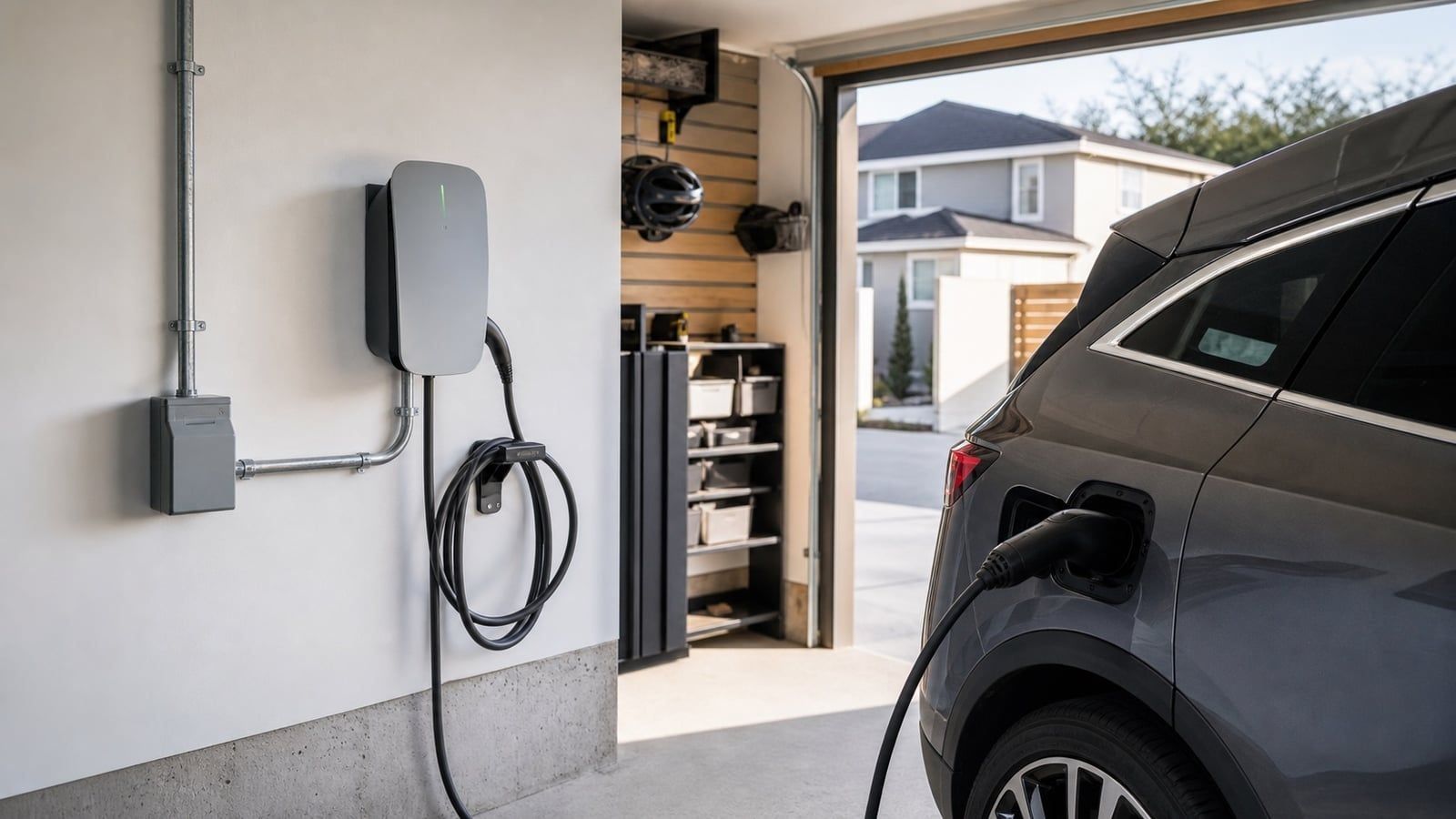
Why does my EV charger keep tripping the breaker?
The most common cause is an undersized breaker for a continuous load. EV charging runs for hours, and the NEC requires the circuit to be sized at 125% of the charger's draw — the 80% rule. A 48A charger on a 50A breaker will trip, because the breaker is carrying a continuous load above 80% of its rating. A 40A charger on a 40A breaker will do the same. The correct pairings are 32A charger on a 40A breaker, 40A on a 50A breaker, and 48A on a 60A breaker. If your install was done without a load calculation or by someone who sized the breaker to the charger rather than above it, this is the likely cause — and the fix is the correct breaker and wire pair, not a bigger breaker on the same wire.
The second common cause is a charger set above its circuit rating. Many smart chargers let you set the maximum amperage in the app, and if the setting is higher than the circuit supports, the breaker trips. A 48A charger on a 40A circuit is the classic case: the charger tries to draw 48A, the 40A breaker trips, and the owner resets it and tries again. Check the charger's amperage setting against the breaker size — they must match the 80% rule. Our breaker and wire size guide has the full table.
GFCI faults and failing breakers
A failing GFCI breaker is the next suspect, especially on NEMA 14-50 installs where GFCI protection is required for garage receptacles. GFCI breakers can fail with age, and they can also trip on genuine ground faults — moisture in an outdoor receptacle, a damaged cable, or a fault inside the charger itself. The 2026 NEC tightens EV-circuit GFCI protection, and two layers of GFCI — the breaker's and the charger's own ground-fault protection — can occasionally argue with each other and cause nuisance trips. An electrician can test the GFCI breaker, check for a genuine fault, and coordinate the two layers so they do not fight.
Breakers also wear out. A breaker that has tripped many times, or one that is old, can become hypersensitive and trip at loads it once carried happily. That is a real failure mode, and it is diagnosed by testing the circuit under load — not by guessing. If the tripping started suddenly after months of trouble-free charging, a failing breaker or a new fault is more likely than a sizing problem, and a diagnosis visit is the right next step.
Loose terminations and heat: the cause that matters most
Loose terminations are the cause that matters most, because they are the one that can start a fire. A wire that was not torqued to specification, or that has loosened over time under the heating and cooling of a continuous load, creates resistance — and resistance creates heat. The heat discolours the terminal, melts the insulation, and eventually damages the receptacle or the breaker. The warning signs are a plug or receptacle that feels hot, a burning smell, discolouration around the terminals, or a breaker that trips more often as the weather gets hotter.
This is the cause that a homeowner cannot safely check: it involves opening the panel and inspecting terminations, which is an electrician's job with the power off and the right tools. If you suspect heat — and any hot plug is a suspicion — stop using the charger and call. Do not “just turn the charger down” and carry on: turning it down reduces the load, but it does not fix a loose termination, and the heat will come back. A diagnosis visit checks the terminations, the breaker and the receptacle together, and it is the cheapest visit you will ever book if it catches a loose connection early.
What you can safely check yourself
There are three safe checks. First, the charger's amperage setting: confirm it matches the circuit under the 80% rule, and lower it if it does not — a 48A charger on a 40A circuit should be set to 32A until the circuit is corrected. Second, the cable and connector: look for damage, cuts, or a connector that no longer latches, and check whether the plug feels hot after a charge. Third, the timing: does it trip immediately, after an hour, or only on hot afternoons? Immediate tripping suggests a fault or a short; tripping after an hour suggests a continuous-load sizing problem; hot-afternoon tripping suggests heat at a termination or a breaker that is failing under temperature.
Write down what you find — when it trips, how hot the plug feels, whether the charger shows a fault light — and give that to the electrician. It shortens the diagnosis considerably. And if the charger shows a red fault light that persists after a power cycle, book a repair diagnosis: it can indicate a ground fault or a hardware issue inside the charger, and it is not something to reset repeatedly.
The fix, and what it costs
The fix depends on the cause. A wrong amperage setting is free — change the setting. A failing GFCI breaker is a breaker replacement. A sizing problem is a circuit correction: the correct breaker and wire pair, and a charger configured to match. A loose termination is a repair and re-torque, and possibly a new receptacle if the old one is heat-damaged. A charger fault is a repair or a replacement — see our guide to replacing or upgrading your charger.
A diagnosis visit is the starting point for all of it, and it is how you avoid paying for the wrong fix. Replacing a healthy charger will not fix a bad circuit, and replacing a breaker will not fix a loose termination. A typical Level 2 install in Orlando runs $800–$2,500 including the charger — but a tripping problem caught early is usually a repair, not a reinstall, and a repair costs far less than either. Stop resetting, book the diagnosis, and let the cause decide the fix.
Questions Homeowners Ask Us
Why does my EV charger keep tripping the breaker?
The most common causes are an undersized breaker for a continuous load, a charger set above its circuit rating, a failing GFCI breaker, or loose terminations heating up. Repeated trips are a heat warning — stop resetting and get a diagnosis.
What size breaker should a 48A charger have?
A 60A breaker, under the NEC 80% rule — 48A divided by 0.8 is 60A. A 48A charger on a 50A breaker will trip repeatedly.
Can a GFCI breaker cause my EV charger to trip?
Yes — a failing GFCI breaker, a genuine ground fault, or a conflict between the breaker's GFCI and the charger's own ground-fault protection can all cause nuisance trips. An electrician can test and coordinate them.
Ready to Get Your Charger Installed?
Every quote starts with a free on-site assessment and load calculation. Call (407) 555-0134 (placeholder) or visit our contact page to book your survey.
Related services: EV charger repair & maintenance, Level 2 EV charger installation, Electrical panel upgrade.
Related guides: EV charger breaker and wire size guide, EV charger maintenance guide, When to replace or upgrade your EV charger.
Service areas: Kissimmee, Winter Park — and all areas on our service areas page. Back to the EV charger guides hub.