NEMA 14-50 vs Hardwired EV Charger
Plug-in flexibility or hardwired speed? The honest comparison, including the 48A limit that decides it for many drivers.
Every Level 2 home install in Orlando comes down to one early decision: plug-in or hardwired? A plug-in charger connects to a NEMA 14-50 outlet — a dedicated 240V, 50-amp receptacle on your garage wall. A hardwired charger is wired directly into its own circuit, with no plug and no receptacle in between. Both charge your car overnight, both are permitted and inspected, and both are legitimate. But they differ in speed, cost, weather resistance and what happens when you move house.
This guide compares NEMA 14-50 vs hardwired directly, so you can choose with the facts. The single most important difference is the speed ceiling: a plug-in install on a NEMA 14-50 outlet delivers up to 40A of continuous charging, while a hardwired install can reach 48A on a 60A circuit. For many drivers that gap does not matter. For some, it decides everything.
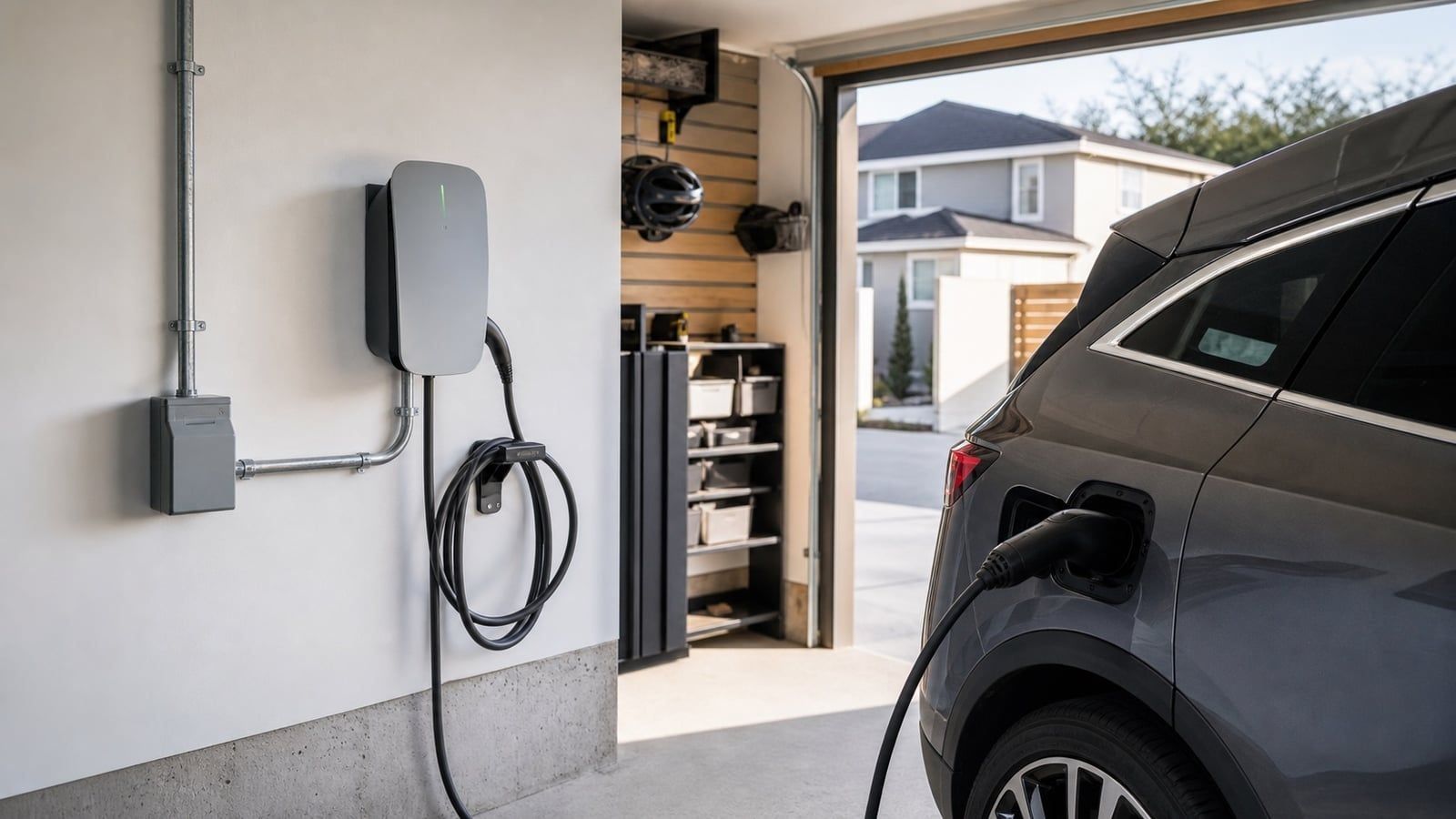
What is a NEMA 14-50 outlet?
A NEMA 14-50 outlet is the standard 240V, 50-amp receptacle used by plug-in EV chargers and RVs — two hot wires, a neutral and a ground, in the configuration electricians call “14-50 NEMA”. What does NEMA 14-50 mean in practice? It means a dedicated 50-amp circuit, GFCI protection for garage receptacles, a permitted install and an inspection, and up to 40A of continuous charging for your car. The 40A limit comes from the 80% rule: a continuous load may only use 80% of its circuit, and 80% of 50 amps is 40 amps.
A NEMA 14-50 installation needs a 50A two-pole GFCI breaker where code requires it, 6 AWG copper wire, an industrial-grade receptacle, a proper box and conduit, and a permit. The receptacle itself matters more than most people expect: cheap residential-grade receptacles are a known failure point under continuous EV loads, and we install industrial-grade receptacles rated for the duty. How do you wire a NEMA 14-50 outlet? That is permitted electrical work with torque specifications, GFCI rules and an inspection — we strongly recommend a licensed install rather than a DIY video.
NEMA 14-50 vs hardwired: speed, cost and reliability
On speed, hardwired wins — but only at the top end. A hardwired 48A charger on a 60A circuit adds roughly 44 miles of range per hour; a plug-in 40A charger on a NEMA 14-50 adds roughly 30–37 miles per hour depending on the car. Both fill a typical daily commute in a few hours overnight, so the difference only matters if you regularly arrive home nearly empty and leave early, or if your car accepts the full 48A. On cost, plug-in usually wins slightly: the outlet install is simpler, and the charger itself can be cheaper. On reliability, hardwired wins: there is no receptacle to wear out, no plug connection to heat up, and no GFCI coordination issue between a receptacle breaker and the charger's own protection.
On flexibility, plug-in wins clearly. A plug-in charger unplugs and travels with you when you move, and it is easy to swap for a different brand when you change cars. A hardwired charger stays on the wall — it can be replaced, but that is an electrician's job at both ends. Renters and anyone who expects to move within a few years should weigh this heavily. Homeowners who plan to stay put and want the fastest, cleanest install usually lean hardwired. There is no universally right answer, only the right answer for your home and your plans.
Outdoor installs: hardwired has the edge
Can home EV chargers be installed outside? Yes — and this is where hardwired pulls ahead. A hardwired outdoor install is sealed at the wall with no exposed receptacle, which handles Florida rain, humidity and hurricane-season weather better than a plug-and-receptacle connection. A NEMA 14-50 outlet can be installed outside, but it needs a weatherproof, in-use cover and careful placement, and the plug connection itself is a point where moisture can intrude. For a driveway or carport install with no garage, we generally recommend hardwired.
That said, many Orlando homes have a garage, and a plug-in install inside a garage is perfectly sound. The outdoor question only tips the decision when the charger will genuinely live outside. Our guide to installing an EV charger outdoors in Florida covers weatherproofing, surge protection and placement in detail.
NEMA 6-50 vs 14-50 — a quick note
You may also see the NEMA 6-50 mentioned in EV forums. The 6-50 is a 240V, 50-amp receptacle with no neutral wire — two hots and a ground only. It works fine for many chargers, which do not need a neutral, but it is less flexible: you cannot use it for an RV or other equipment that needs a neutral. The 14-50 is the more common and more versatile choice for a home EV install, and it is the one most electricians will recommend unless there is a specific reason to use a 6-50. Either way, the circuit is dedicated, permitted, GFCI-protected where required, and inspected.
One more comparison worth making: a NEMA 14-50 outlet is not a substitute for a proper Level 2 charger install. The outlet is the connection point; the charger is the device that safely manages the power, communicates with the car, and schedules charging. A mobile connector plugged into a 14-50 works, but a dedicated wall charger is faster, more convenient and more durable for daily use. Think of the outlet as the socket and the charger as the appliance — you need both, and both need to be sized correctly.
Which should you choose?
Choose a NEMA 14-50 plug-in install if you rent, expect to move, want the flexibility to swap chargers, or want the lowest upfront cost. Choose hardwired if you want the fastest home charging at 48A, an outdoor install, the cleanest look, or a permanent setup for a car you will keep for years. If you are still unsure, the site survey settles it: we look at your panel, your parking and your driving, and recommend the option that fits — and we will tell you honestly when the cheaper plug-in option is all you need.
Either way, the price is in the same range: a typical Level 2 home install in Orlando runs $800–$2,500 including the charger, with simple short-run jobs from around $599. The outlet-versus-hardwired choice moves the price by a modest amount; the wire run and the panel move it far more.
Questions Homeowners Ask Us
What is a NEMA 14-50 outlet?
It is the standard 240V, 50-amp receptacle used by plug-in EV chargers and RVs — two hots, a neutral and a ground. A NEMA 14-50 EV charger setup delivers up to 40A of continuous charging.
NEMA 14-50 vs hardwired — which is better?
Hardwired is faster (up to 48A) and better outdoors; plug-in is more flexible and slightly cheaper, and it travels with you if you move. Most drivers are happy with either — the choice depends on your plans.
How do you wire a NEMA 14-50 outlet?
It is permitted electrical work: a dedicated 50A circuit, 6 AWG copper, a GFCI breaker where required, an industrial-grade receptacle and an inspection. Always use a licensed electrician — no DIY wiring instructions here.
Can a NEMA 14-50 outlet be installed outside?
Yes, with a weatherproof in-use cover and correct placement — but a hardwired install is generally the better choice for a charger that will live outdoors in Florida weather.
Ready to Get Your Charger Installed?
Every quote starts with a free on-site assessment and load calculation. Call (407) 555-0134 (placeholder) or visit our contact page to book your survey.
Related services: NEMA 14-50 outlet installation, Level 2 EV charger installation, Tesla Wall Connector installation.
Related guides: EV charger breaker and wire size guide, Tesla Wall Connector vs ChargePoint, When to replace or upgrade your EV charger.
Service areas: Oviedo, Winter Springs — and all areas on our service areas page. Back to the EV charger guides hub.