EV Charger Plugs, Connectors and Adapters
J1772, NACS, CCS and CHAdeMO — what each plug is, which cars use it, and which adapters are safe to use.
Walk into any conversation about EV charging and the plugs come up within minutes: J1772, NACS, CCS, CHAdeMO. Different types of EV charging plugs exist because different makers, different countries and different charging speeds each grew their own connector — and now the industry is consolidating around one. If you are buying a home charger, the plug question is really one question: what connector does your car take, and does your charger match it natively?
This guide explains every EV charger plug and EV charge connector you are likely to meet in Orlando, what each one is for, and how adapters fit in. The rule that runs through all of it: a native connector is always better than an adapter, and adapters are for AC home charging only unless they are specifically rated otherwise. Buy listed, name-brand adapters only — a cheap unlisted adapter on a 40-amp circuit is a fire risk.
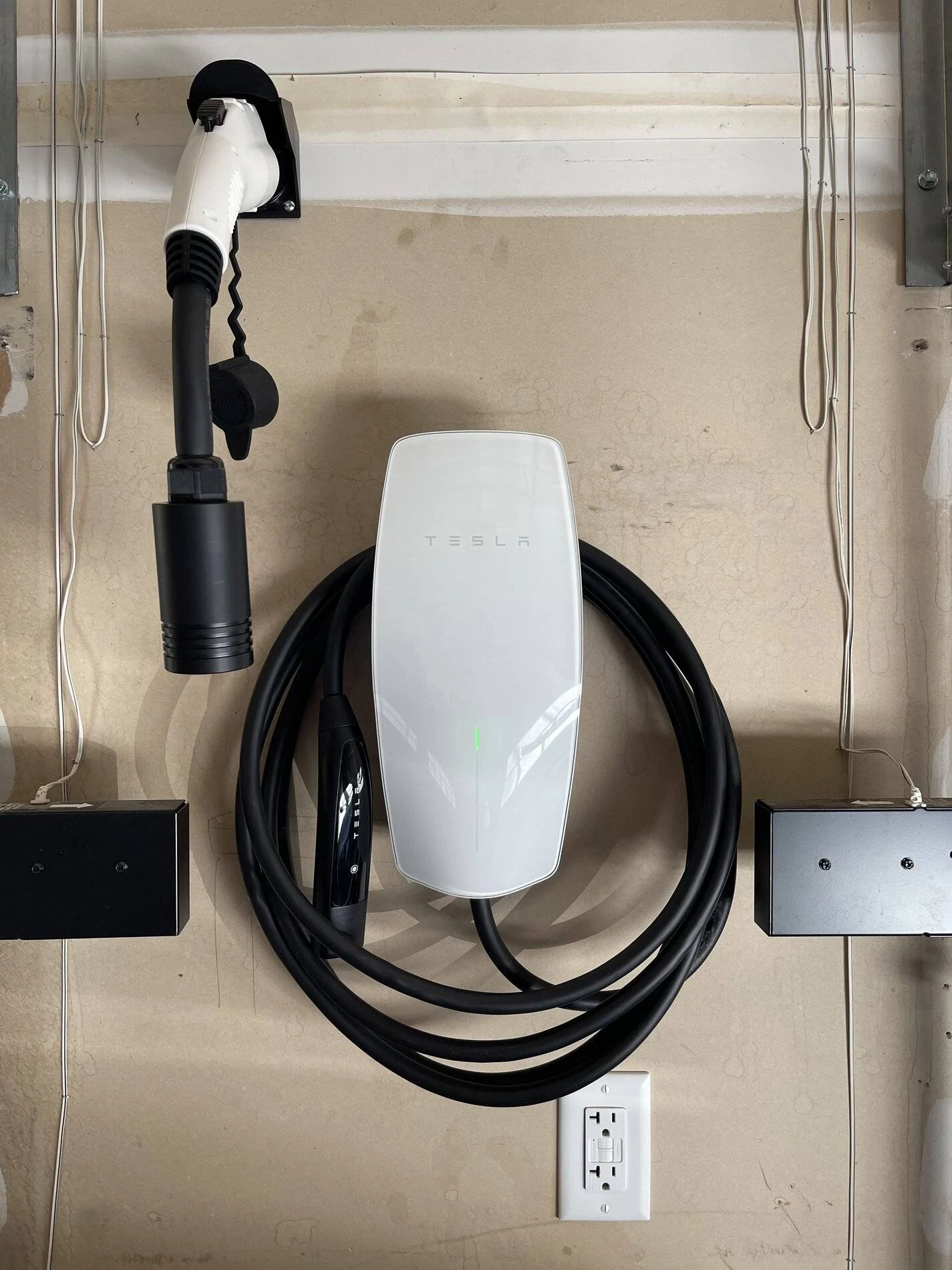
J1772: the standard plug for most non-Tesla cars
J1772 — formally SAE J1772 — is the connector fitted to most non-Tesla electric cars sold in North America for Level 1 and Level 2 AC charging: Ford, Rivian, Hyundai, Kia, Chevrolet, Nissan, BMW and others. If your car is not a Tesla and was built before the industry's switch to NACS, it almost certainly has a J1772 inlet. A home charger with a J1772 plug, such as a ChargePoint Home Flex with the J1772 cable, plugs straight in with no adapter. It is a well-proven connector, rated for the full range of home Level 2 charging up to 48A and beyond.
J1772 is an AC-only connector. It carries the alternating current from your home charger to the car, where the car's onboard charger converts it to DC for the battery. That is the normal pattern for home charging, and it is why the J1772 versus NACS question is really a home-charging question. For DC fast charging on the road, non-Tesla cars with J1772 use a separate, larger CCS connector — see below. If you are buying a home charger for a J1772 car, a J1772 charger is the straightforward choice, and it is the one we install most often for non-Tesla households.
NACS: Tesla's connector, now the North American standard
NACS — the North American Charging Standard — is Tesla's connector. Every Tesla uses it, and it is now being adopted across the industry: most major makers have announced a switch to NACS for new models, and public fast-charging networks are adding NACS cables. The Tesla Wall Connector uses a NACS plug natively, which is one reason Tesla drivers usually choose it. NACS handles both AC home charging and DC fast charging through the same compact plug, which is part of its appeal — one connector, both speeds, no separate inlet.
If you drive a Tesla, a NACS charger is the obvious match. If you drive a non-Tesla that is switching to NACS in a future model year, check your specific car's inlet before ordering a charger — the changeover is happening model by model, not all at once. And if you drive a J1772 car today, a NACS charger with a J1772 adapter works, but a native J1772 charger is simpler and cheaper. The connector landscape is converging, but it has not finished converging yet.
CCS and CHAdeMO: DC fast charging plugs you will not use at home
CCS — the Combined Charging System — is the DC fast-charging connector for most non-Tesla cars in North America. It is essentially a J1772 plug with two large DC pins added underneath, and it is what you plug into at a DC fast charger on the highway. CHAdeMO is the older Japanese DC fast-charging standard, used mainly by the Nissan Leaf and a few other early models; it is fading from new cars and new charging stations. Neither CCS nor CHAdeMO is a home-charging connector: Level 3 DC fast charging is commercial-only equipment, running at 400V+ DC and far beyond anything a home circuit supplies.
Why does this matter for a home install? Because it tells you what not to buy. No home charger needs a CCS or CHAdeMO plug, and no home install should be sold as “Level 3”. If a listing promises DC fast charging at home, it is either mislabelled or commercial equipment. Your home charger will be J1772 or NACS, Level 2, on a 240V circuit — and that is exactly right for overnight charging. Our Level 1 vs Level 2 vs Level 3 guide explains the three levels in full.
EV connectors and adapters: what is safe to use?
Adapters bridge the two AC worlds: J1772 to NACS and NACS to J1772. They are useful in two situations — visiting a public charger with the other connector, and using a charger you already own with a new car that has the other inlet. For home use, an adapter is a workaround, not a plan: every adapter adds a connection point, and every connection point is a place where heat and wear can build up under a continuous 32A or 40A load. If you are buying a new charger, buy the native connector for your car and skip the adapter entirely.
When you do need an adapter, buy it from a listed, name-brand maker and check its current rating matches your charging amperage. Cheap unlisted adapters are a known cause of melted inlets and damaged charge ports, and they can void a charger's warranty. The same rule applies to extension cords for EV charging: do not use them. If the charger cable does not reach your car, the answer is a better charger location or a longer-cable charger, not an extension. Your electrician can confirm the right cable length at the survey.
Choosing the right plug for your home charger
The decision is short. Tesla today: NACS, and the Tesla Wall Connector is the natural match. Non-Tesla with J1772: a J1772 charger such as the ChargePoint Home Flex, Wallbox, Emporia or Grizzl-E with a J1772 cable. Non-Tesla switching to NACS in a future model: check your exact model year, and if in doubt choose the connector your current car has — you can change the charger when you change the car. Two-EV household with one of each: either two chargers with native connectors, or one charger plus a quality adapter for the second car.
Whatever connector you choose, the electrical work is the same: a permitted 240V circuit, correctly sized breaker and wire, a load calculation, and an inspection. A typical Level 2 home install in Orlando runs $800–$2,500 including the charger, with simple short-run jobs from around $599. Tell us your car's make, model and year at the survey and we will confirm the connector before we quote.
Questions Homeowners Ask Us
What are the different types of EV charging plugs?
The main AC plugs are J1772 (most non-Tesla cars) and NACS (Tesla, now the North American standard). CCS and CHAdeMO are DC fast-charging plugs for public stations, not home charging.
What is the difference between J1772 and NACS?
J1772 is the long-standing AC connector for most non-Tesla cars; NACS is Tesla's connector, now being adopted industry-wide, and it handles both AC and DC charging through one compact plug.
Can I use an adapter between J1772 and NACS?
Yes, for AC charging — but a native connector is always better for daily home use. Buy listed, name-brand adapters only, rated for your charging amperage, and never use an extension cord for EV charging.
What is a CCS connector?
CCS is the Combined Charging System plug for DC fast charging on most non-Tesla cars — a J1772 plug with two DC pins added. It is a public fast-charging connector, not a home charger plug.
Ready to Get Your Charger Installed?
Every quote starts with a free on-site assessment and load calculation. Call (407) 555-0134 (placeholder) or visit our contact page to book your survey.
Related services: Level 2 EV charger installation, Tesla Wall Connector installation, Residential EV charger installation.
Related guides: Tesla Wall Connector vs ChargePoint, Level 1 vs Level 2 vs Level 3 charging, First EV home charging beginners guide.
Service areas: Lake Nona, Dr. Phillips — and all areas on our service areas page. Back to the EV charger guides hub.
Plugs, Connectors and Who Installs Them
Electric car charger plugs, electric vehicle charging plugs and electric car charging plugs all use the same two connectors in the US today: J1772 and NACS (Tesla). An EV charger connector is the plug on the end of the cable — and an EV charge point installer is the electrician who wires the unit it belongs to. EV charging point installers across Orlando do the same work for homes, workplaces and fleets. EV charging point installation and electric vehicle charging point installation mean the same thing: the charger, the circuit and the permit.