Installing an EV Charger Outdoors in Florida
Florida rain, heat, humidity and hurricane season — what an outdoor charger install needs to survive them all.
Not every Orlando home has a garage — and even the ones that do sometimes park the EV in the driveway. Can home EV chargers be installed outside? Yes, and in Florida they are installed outside every week: on driveway walls, carports, detached garages and pedestals. But an outdoor EV charger installation is not the same as a garage install moved outside. Florida's rain, heat, humidity, UV and hurricane-season storms each put specific demands on the equipment, the mounting and the wiring.
This guide covers what outdoor installation actually requires: weather-rated equipment, GFCI protection, surge protection, conduit that handles heat and UV, and placement that keeps the charger usable in a downpour. Get those right and an outdoor charger is as reliable as a garage one. Get them wrong and you will be troubleshooting faults every rainy season.
Can a Tesla Wall Connector be installed outside?
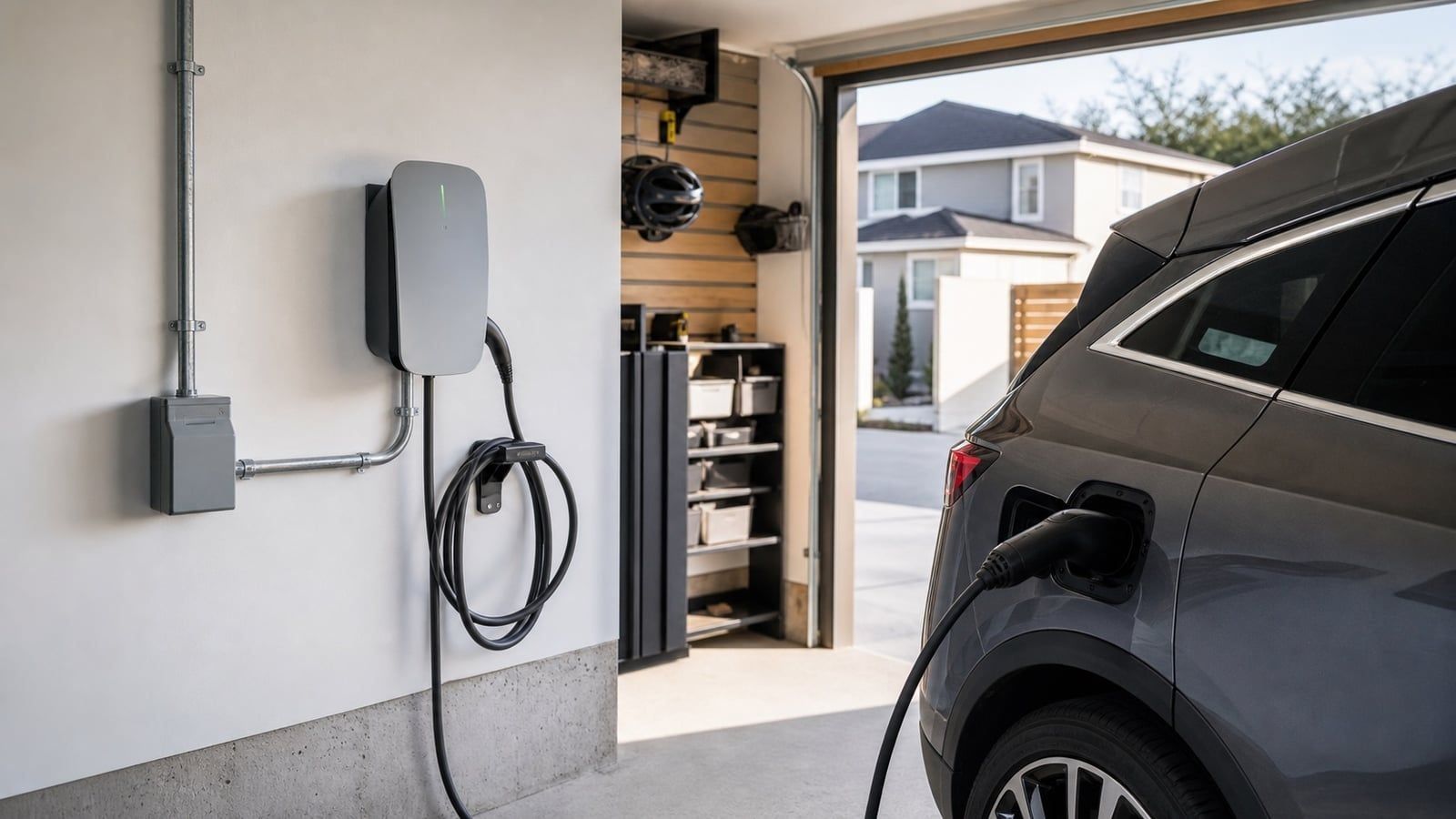
Yes — the Tesla Wall Connector is outdoor-rated, and it is one of the most common outdoor installs we do. “Can a Tesla Wall Connector be installed outside?” is the single most-asked outdoor question, and the answer is straightforward: it is designed for it, provided it is mounted, sealed and tested correctly. That means a solid mounting surface, the cable entry sealed against rain, the unit positioned so driving rain does not sit on its seals, and the circuit protected as described below. An outdoor-rated charger on a bad mount is still a bad install.
The same applies to other outdoor-rated chargers: ChargePoint Home Flex, Wallbox, Emporia and Grizzl-E all have outdoor-rated options, and Grizzl-E in particular is known for rugged, outdoor-tough construction. What matters is not just the charger's rating but the whole install — the enclosure, the conduit, the connections and the placement. Ask your installer to confirm the charger's weather rating in writing before you choose, and do not assume a charger that is fine in a garage is fine on an exposed driveway wall.
Weatherproofing: ratings, seals and conduit
Outdoor EV charger installation in Florida means weather-rated equipment — typically NEMA 3R or NEMA 4 enclosures, which protect against rain, sleet and windblown dust — and conduit that handles heat and UV without degrading. The charger is mounted on a solid surface, sealed where the cable enters, and positioned with the connector holster protected from direct rain. The cable itself needs a holster or hook that keeps it off the ground: a cable lying in a puddle is a failure waiting to happen, and a cable baking on hot concrete wears faster.
Placement matters as much as hardware. The charger should sit where you actually park, with the cable reaching the car's charge port without stretching across a walkway. It should be shaded where possible — direct Florida sun heats the unit and the cable, and heat is the enemy of electronics and insulation alike. And it should be reachable without standing in a puddle in a thunderstorm. A few minutes of placement thinking at the survey saves years of annoyance.
GFCI and surge protection outdoors
GFCI protection is required for outdoor receptacles and is standard practice on outdoor EV circuits. If your outdoor install uses a NEMA 14-50 outlet, expect a GFCI breaker and a weatherproof, in-use cover that protects the connection while the charger is plugged in. If it is hardwired, the charger's own ground-fault protection and the circuit protection are coordinated by the installer so they do not fight each other. Either way, the inspector will check it — outdoor circuits get close attention precisely because water and electricity are a bad combination.
Surge protection matters more outdoors than in a garage, and more in Central Florida than almost anywhere else — this is the lightning capital of the country. A whole-home or dedicated surge protection device on the EV circuit protects the charger and the car from the voltage spikes that come with summer thunderstorms. It is a modest addition to the job and a cheap one compared with a fried charger. Mention it at the survey if your home does not already have surge protection.
Hardwired or plug-in for an outdoor install?
For a charger that will live outdoors, hardwired is generally the better choice. A hardwired install is sealed at the wall with no exposed receptacle, so there is no plug connection for rain to intrude into. A NEMA 14-50 outlet can be installed outside with a weatherproof in-use cover, and it works, but the plug connection is a point where moisture can get in over time, and the cover itself needs to be kept in good condition. If you rent or expect to move, the plug-in route still has its flexibility advantage — but for a permanent outdoor install, hardwired is the recommendation most electricians will give.
The speed question points the same way. A hardwired install can reach 48A on a 60A circuit; a plug-in install on a NEMA 14-50 tops out at 40A. Outdoors, where the charger may also be dealing with heat, the cleaner and simpler the connection, the better. Our NEMA 14-50 vs hardwired guide compares the two in full, including the moving-house question.
What an outdoor install costs and how long it takes
An outdoor install costs a little more than a garage install, mainly for the weatherproofing: the rated enclosure, the in-use cover or sealed entry, the surge protection, and sometimes a longer wire run to reach the driveway or a detached garage. A typical Level 2 home install in Orlando runs $800–$2,500 including the charger, with simple short-run jobs from around $599; an outdoor job usually sits in the middle of that range unless the run is long or trenching is needed. Trenching to a detached garage is the one cost that can move the price substantially, because it involves digging, conduit and restoration.
Timing is the same as any Level 2 install: a permitted install is usually finished in a single visit once the permit is approved, with the inspection scheduled after. The survey is where the outdoor questions get answered — where the charger will sit, how the wire gets there, whether trenching is needed, and what the total price will be. Book the survey and walk the driveway with the electrician: the best placement is obvious once you are standing in it.
Questions Homeowners Ask Us
Can home EV chargers be installed outside?
Yes. Outdoor EV charger installation uses weather-rated equipment, GFCI protection, surge protection and sealed mounting. Many Orlando homes charge outdoors on driveways, carports and detached garages.
Can a Tesla Wall Connector be installed outside?
Yes — it is outdoor-rated. It needs correct mounting, sealed cable entry and GFCI protection, and we mount, seal and test outdoor installs for Florida weather.
Is a hardwired or plug-in charger better outdoors?
Hardwired is generally better outdoors: it is sealed at the wall with no exposed receptacle for rain to enter, and it can reach 48A. A plug-in NEMA 14-50 can work outdoors with a weatherproof in-use cover.
Does an outdoor EV charger need surge protection?
It is strongly recommended in Central Florida, the lightning capital of the country. Surge protection on the EV circuit protects the charger and the car from thunderstorm voltage spikes.
Ready to Get Your Charger Installed?
Every quote starts with a free on-site assessment and load calculation. Call (407) 555-0134 (placeholder) or visit our contact page to book your survey.
Related services: Level 2 EV charger installation, Tesla Wall Connector installation, NEMA 14-50 outlet installation.
Related guides: NEMA 14-50 vs hardwired EV charger, Tesla Wall Connector ownership guide, EV charger maintenance guide.
Service areas: Windermere, Winter Garden — and all areas on our service areas page. Back to the EV charger guides hub.