Do You Need a Panel Upgrade for an EV Charger?
Do you need a panel upgrade for an EV charger? It is the question that decides whether your install costs hundreds or thousands of dollars more — and the honest answer is that most Orlando homeowners do not need one. A load calculation decides it, not a guess, not a sales pitch, and not the age of the panel alone. This guide explains how the verdict is reached, the cheaper alternatives, and the cases where an upgrade is genuinely the right call.
Orlando EV Installers starts every quote with a site survey and a load calculation, and we only recommend panel work when the numbers require it. Call (407) 555-0134 (placeholder) and we will check your panel before quoting anything. A typical Level 2 home install runs $800–$2,500 including the charger, with simple short-run jobs from around $599. Panel work, when genuinely needed, adds roughly $2,000–$5,000.
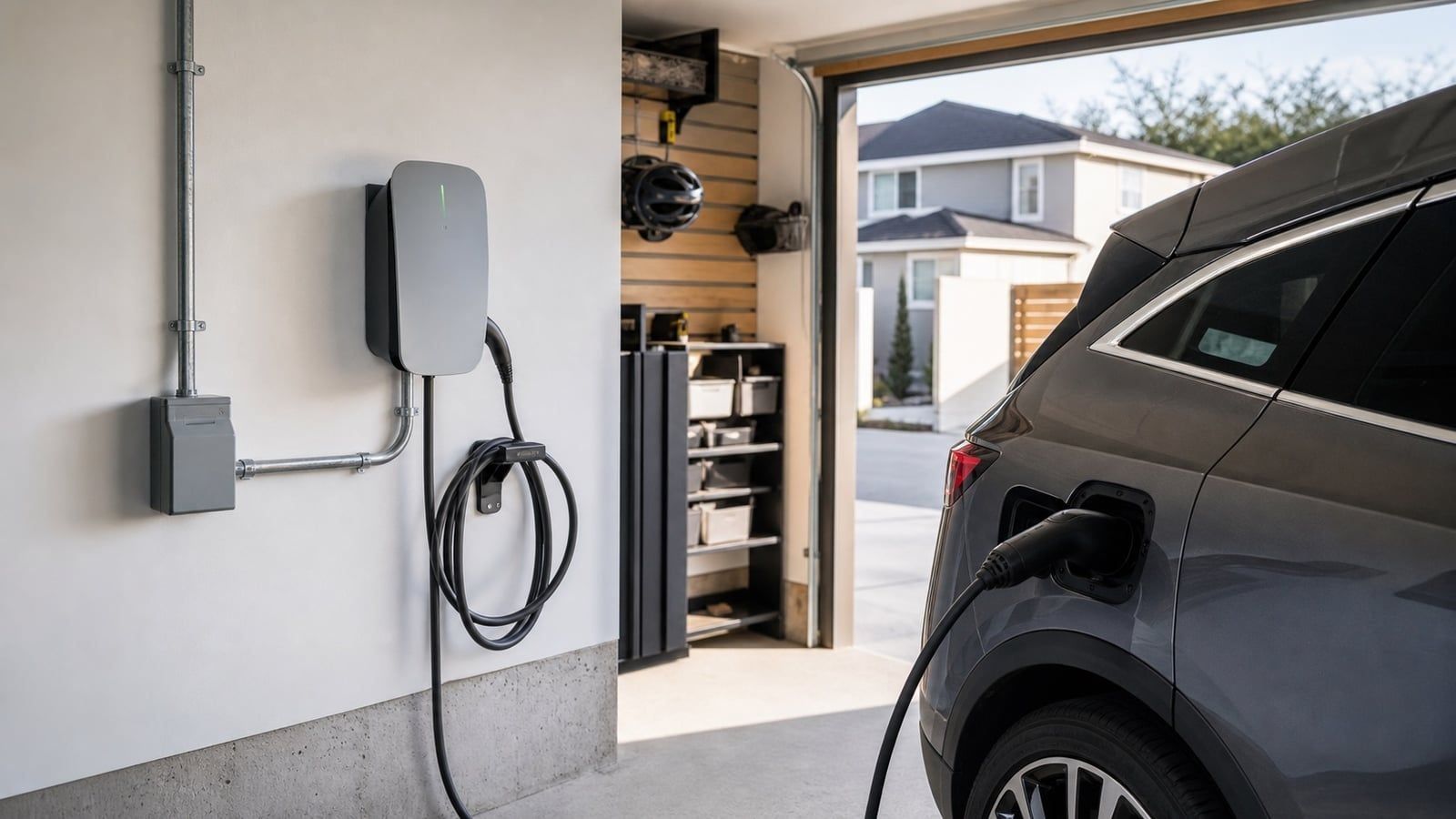
The Load-Calculation Verdict
The load calculation follows NEC Article 220. It totals the loads your home is expected to draw at the same time — lighting and receptacles by square footage, air conditioning, cooking, water heating, laundry, pool equipment — and compares that total with your service size. EV charging counts as a continuous load, so the circuit is sized at 125 percent of the charger draw under the NEC 80 percent rule: a 32-amp charger needs a 40-amp breaker, a 40-amp charger needs a 50-amp breaker, and a 48-amp charger needs a 60-amp breaker with 6 AWG copper wire, hardwired only.
Does my panel have capacity for a 50A or 60A breaker? On a 200-amp service, usually yes — a 200-amp panel has enough total capacity for a 50-amp or 60-amp EV circuit alongside normal household loads, and it usually has the breaker space too. On a 100-amp service, it depends entirely on what else the house draws. A small home with gas cooking and gas water heating may fit a 40-amp circuit comfortably; a larger all-electric home with a pool pump may not fit even a 30-amp circuit without management. The service size is a clue, never a verdict.
Is there an empty slot in my panel for a new breaker? That is the other half of the question. A panel can have spare capacity but no spare slot, or a spare slot but no spare capacity. Both must be true before a charger goes in. A licensed electrician checks both — the slot, the busbar rating, the condition of the breakers and the wire — during the site survey.
The Cheaper Alternatives, in Order
Before anyone talks about an upgrade, these are the options we try, in this order.
Charge at a lower amperage
Most Level 2 chargers can be commissioned at 24 or 32 amps instead of 40 or 48. At 32 amps you still add about 25 miles of range per hour, and at 24 amps about 18 miles per hour — enough to restore a typical daily drive overnight. The breaker and wire are sized to match the setting, so the install is safe and code-compliant at the lower level. This alone solves the problem for many 100-amp homes, and it is the first thing to try.
Add a load management device
A load management device watches the whole home's demand and pauses or slows EV charging when the air conditioner, dryer or oven is running hard, resuming when capacity frees up. NEC 220.70 covers managed chargers. Your car still charges overnight; it simply never charges at the exact moment the house is at peak load. This is often the best value answer for a tight panel, and it costs far less than a service upgrade.
Add a subpanel
If the problem is breaker space rather than total capacity — the panel is full but the load calculation shows room — a subpanel creates the slots the charger needs. It is a smaller job than a full upgrade, but it only works when the service genuinely has spare capacity. A subpanel does not create amps that are not there.
Share one charger between two EVs
If the household has two EVs, one charger with power sharing, or a single charger used on alternate nights, may be enough — and it avoids a second large circuit entirely. Our guide to charging two EVs at home explains the options.
When an Upgrade Is Genuinely Needed
An upgrade is the right answer when the load calculation leaves no safe alternative. That happens when the service is already overloaded without the charger, when the panel itself is damaged, overheating or obsolete, when the household wants a 48-amp charger and a second EV on a 100-amp service, or when a future electric range, heat pump or tankless water heater is planned and the service cannot carry it all. In those cases a 100-amp to 200-amp upgrade is an investment in the whole house, not just the car — and it is better to do it once, properly, than to squeeze in a charger that trips the main breaker every summer evening.
An upgrade involves the utility, a permit and an inspection, and it adds calendar time to the job. Our guide to how long installation takes explains the timeline, and our Orlando permit guide covers the permit and inspection. Panel work adds roughly $2,000–$5,000; the exact figure depends on the panel location, the service entry and the work the utility requires.
Older Homes, Newer Homes
In older Orlando neighbourhoods — Winter Park, College Park, Maitland, Kissimmee and the older parts of Apopka — 100-amp panels are common, and the load calculation is the step that matters most. Some of those panels are in good condition and fit a managed 32-amp charger with no work at all. Others are tired, full or damaged, and an upgrade is the honest recommendation. In newer areas such as Horizon West, Lake Nona and parts of Oviedo, 200-amp panels and pre-wired garages are the norm, and the question rarely comes up. The build era is a hint; the panel inspection is the answer.
Be wary of any quote that recommends an upgrade without showing you a load calculation, and equally wary of any quote that promises a 48-amp charger on a 100-amp panel with no management and no calculation. Both are red flags. A trustworthy installer shows the numbers, explains the alternatives, and lets you choose.
The Bottom Line
Start with a load calculation. Try a lower amperage or a load management device. Add a subpanel if space is the only problem. Upgrade only when the numbers say you must. That order keeps most installs in the typical $800–$2,500 range and reserves the extra $2,000–$5,000 for the homes that genuinely need it.
Orlando EV Installers are licensed and insured Florida electricians, and we handle permits and inspection on every job, with a load calculation first. Call (407) 555-0134 (placeholder), or see our electrical panel upgrade service, our Level 2 EV charger installation and our residential EV charger installation. Related reading: our 100-amp panel guide, our EV charger load management guide and our breaker and wire size guide. We serve Winter Park and Kissimmee and all of Central Florida — more in the blog and guides hub.
Questions Homeowners Ask Us
Do I need a panel upgrade for an EV charger?
Not always. A load calculation under NEC Article 220 decides it. Many homes fit a 24-amp or 32-amp charger, or a load management device, without any panel work. An upgrade is needed only when the calculation shows the service cannot safely carry the charger.
Does my panel have capacity for a 50A or 60A breaker?
It depends on the service size, the existing loads and the spare breaker space. A 200-amp panel usually has room for a 50-amp or 60-amp breaker; a 100-amp panel may not. Only a load calculation and a panel inspection give a reliable answer.
Is there an empty slot in my panel for a new breaker?
Check the panel cover for unused breaker positions, but a slot alone is not enough — the service must also have spare capacity. A full panel can sometimes be solved with a subpanel; a panel with no spare capacity needs load management or an upgrade.
How much does it cost to upgrade an electrical panel for an EV charger?
Panel work adds roughly $2,000–$5,000 to a job when the load calculation requires it. A typical Level 2 install without panel work runs $800–$2,500 including the charger, with simple jobs from around $599.
Can a load management device help me avoid a panel upgrade?
Yes. It monitors total household demand and slows or pauses EV charging when other large loads are running, then resumes when capacity frees up. It is often the cheapest safe alternative to an upgrade.