EV Charger Noise and Heat
Your EV hums, clicks and whirs while it charges. Most of it is normal. Here is how to tell the sounds that are fine from the ones that are not.
EV making noise while charging? It is one of the first things a new owner notices: the car hums, something clicks, a fan starts, and the whole garage sounds faintly alive at midnight. Most of that noise is normal — fans, coolant pumps and contactor clicks are part of how an EV charges safely. But some noises are not normal, and the difference matters: a loud buzz from the charger or the panel, or a plug that is too hot to touch, is a warning, not a quirk.
This guide covers EV charger noise and heat together, because they are linked: the sounds tell you what is working, and the heat tells you what is not. It explains what is normal, what is not, and what to do in each case.
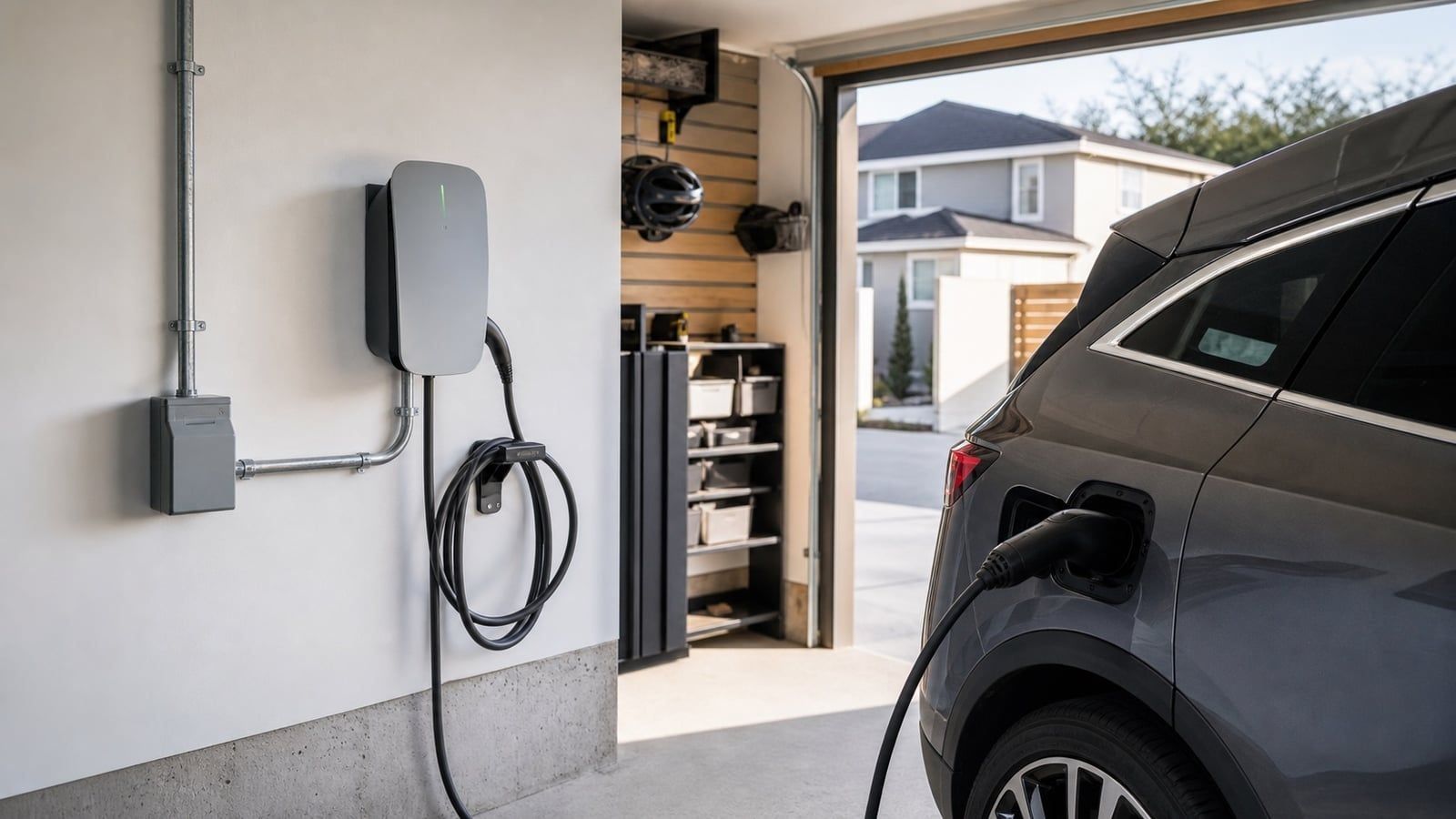
EV making noise while charging: what is normal?
EV making noise while charging is normal, and the normal sounds have specific sources. Fans cool the car's battery and the onboard charger, and they run harder in Florida heat and at higher charging speeds — a fan that is loud on a hot afternoon is doing its job. Coolant pumps circulate fluid through the battery pack, and they make a soft whir or hum. Contactors — the heavy-duty switches that connect and disconnect the high-voltage battery — make a distinct click or clunk when charging starts and stops. And the charger itself may hum faintly as it delivers power. All of that is expected, and it varies with the car, the temperature and the charging speed.
The pattern to learn is your car's normal pattern. A Tesla, a Ford, a Hyundai and a Rivian each sound slightly different, and each sounds different at the start of a charge, in the middle, and as the battery fills. Spend a few nights listening — not anxiously, just noticing — and you will know what “normal” sounds like for your car. That baseline is what lets you spot a change, and a change is the thing that matters.
What is not normal: buzzing, grinding and loud humming
What is not normal is a loud buzz from the charger or the panel, a grinding or rattling sound, a hum that is suddenly much louder than usual, or any sound accompanied by a burning smell. A loud buzz from the panel can mean a loose breaker or a failing contactor; a buzz from the charger can mean a failing component inside the unit; a grinding sound from the car can mean a failing coolant pump. None of those are “wait and see” sounds — they are “stop charging and call” sounds, particularly if they are new, getting louder, or accompanied by heat or a smell.
The other not-normal sound is silence where there should be sound: a charger that used to click and hum and now does nothing, or a car that starts charging and stops without explanation. That is usually an electrical fault or a charger fault, and our tripping-breaker guide covers the diagnosis. In both cases — a new bad sound, or a missing normal sound — the right move is the same: stop, note what you heard and when, and call your installer.
EV charger heat: warm is normal, hot is not
EV charger noise and heat go together, and the heat rule is simple: warm is normal, hot is not. At 48A, the cable and the connector will feel warm — that is the physics of carrying 48 amps for hours, and it is expected. The plug, the receptacle and the breaker will be warm too. What is not normal is a plug, cable or receptacle that is too hot to touch comfortably, a burning smell, discolouration around a terminal, or a breaker that feels hot. Those are signs of resistance — usually a loose termination or a worn receptacle — and resistance creates heat that gets worse over time.
Florida heat makes the judgement harder, because everything in a garage is warm in August. The test is comparative: if the plug is noticeably hotter than the cable a foot away, or hotter than it was last month, that is a change worth checking. And the test is also about the charger itself: a wall unit that is hot to the touch, or a cable that is hot along its whole length, is not normal. Stop using the charger, leave the breaker off if anything smells hot, and call an electrician. Do not keep charging through a heat problem.
Why heat builds up: loose connections and undersized circuits
Heat builds up for two main reasons, and both are installation issues. The first is loose terminations: a wire that was not torqued to specification, or that has loosened over time, creates resistance at the connection, and resistance creates heat. The second is an undersized circuit: a charger drawing more than its circuit is rated for, or a breaker and wire pair that does not follow the 80% rule, will run hot and trip repeatedly. Both are caught by an inspection of the terminations, the breaker and the receptacle — and both are fixed by correcting the installation, not by turning the charger down and hoping.
Turning the charger down can help as a temporary measure — a 48A charger set to 32A draws less current and generates less heat — but it is a workaround, not a fix. A loose termination will still heat up, just more slowly, and the underlying problem remains. The fix is an electrician's visit: re-torque the terminations, replace a heat-damaged receptacle, correct the breaker and wire sizing, and test under load. Our breaker and wire size guide has the correct pairings.
Living with the sounds: habits that help
The habits that help are the same ones that help everywhere in this guide: keep the cable on its holster, off the floor and out of direct sun; keep the area around the charger clear so air can circulate; keep the vents clear; and check the cable, connector and plug quarterly for wear and heat. Charging overnight, when the air is cooler, is gentler on the equipment than charging in the heat of the afternoon, and scheduling is free — set the departure time and let the charger work out when to start.
And learn your car's normal sounds. The first month with a new EV is the time to notice what it sounds like when it charges — the fans, the clicks, the hum — so that a change six months later is obvious. A typical Level 2 install in Orlando runs $800–$2,500 including the charger, with simple short-run jobs from around $599; a charger that is looked after lasts 10–15 years or more, and the sounds it makes are part of how it tells you it is healthy.
Questions Homeowners Ask Us
Why is my EV making noise while charging?
Fans, coolant pumps and contactor clicks are normal — they cool the battery and connect the high-voltage system. A loud buzz, grinding, or a sound with a burning smell is not normal; stop charging and call an electrician.
Is it normal for an EV charger cable to feel warm?
Yes — warm cables at 48A are expected. Too hot to touch, a burning smell, or discolouration is not normal and means a loose termination or a worn receptacle. Stop using the charger and call for a check.
What causes an EV charger to buzz loudly?
A loud buzz from the charger or panel can mean a loose breaker, a failing contactor or a failing component inside the unit. Stop charging and book a diagnosis — do not keep resetting it.
Does Florida heat make EV charging noisier?
Yes — fans run harder in Florida heat and at higher charging speeds, so summer charging is louder than winter charging. That is normal; a sudden change in the sound is what matters.
Ready to Get Your Charger Installed?
Every quote starts with a free on-site assessment and load calculation. Call (407) 555-0134 (placeholder) or visit our contact page to book your survey.
Related services: EV charger repair & maintenance, Level 2 EV charger installation, Residential EV charger installation.
Related guides: EV charger keeps tripping breaker, EV charger maintenance guide, First EV home charging beginners guide.
Service areas: Kissimmee, Apopka — and all areas on our service areas page. Back to the EV charger guides hub.