EV Charger Breaker and Wire Size Guide
The 80% rule, the breaker table, wire gauge and GFCI — everything that decides whether your Level 2 charger runs safely for years.
Search “48 amp EV charger wire size” and you will find a dozen conflicting answers. The correct one is simple and it comes from the National Electrical Code: EV charging is a continuous load, so the circuit must be sized at 125% of the charger's draw — the 80% rule. A 48A charger needs a 60A breaker and 6 AWG copper conductors. A 32A charger needs a 40A breaker. A 40A charger needs a 50A breaker. Get those three pairings right and most breaker and wire questions answer themselves.
This guide is the full reference: what size breaker for a Level 2 charger, the EV charger wire gauge for each amperage, when GFCI protection is required, and why guessing at any of these is the most common cause of a charger that keeps tripping its breaker. It is general information for homeowners — the actual sizing for your home comes from a load calculation by a licensed electrician, because wire length, temperature, conduit and your panel all affect the final answer.
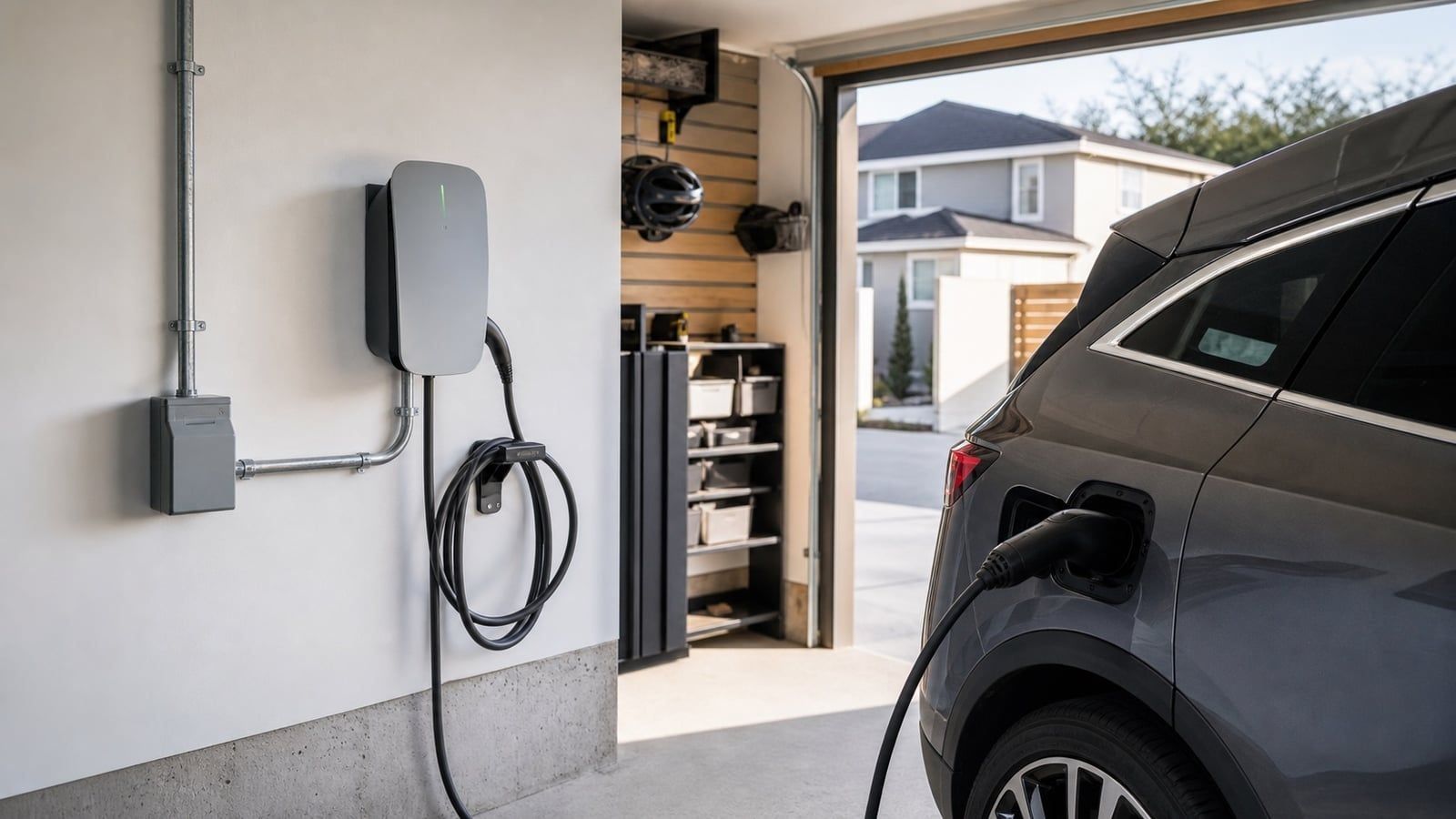
What size breaker for a Level 2 charger? The 80% rule
The NEC treats EV charging as a continuous load, meaning a load that runs for three hours or more — and an overnight charge certainly does. A continuous load may only use 80% of its circuit's rating, so the breaker must be rated at 125% of the charger's draw. That is the whole rule: divide the charger's amps by 0.8 and you get the breaker size. A 32-amp charger divided by 0.8 is 40 amps. A 40-amp charger needs a 50-amp breaker. A 48-amp charger needs a 60-amp breaker. There is no shortcut around this, and a breaker sized exactly to the charger — a 48A charger on a 50A breaker, for example — will trip, heat up, and fail inspection.
How many amps for a Level 2 EV charger, overall? Most home Level 2 chargers draw 32A to 48A, on 40A to 60A circuits. Smaller plug-in chargers may draw 16A on a 20A circuit or 24A on a 30A circuit, and the same rule applies: 16A needs a 20A breaker, 24A needs a 30A breaker. The pattern is consistent because the rule is consistent. Your car's onboard charger also caps the speed — a car that accepts only 32A gains nothing from a 48A circuit — so the right size is the one that matches both the charger and the car, on a panel that can carry it.
48 amp EV charger wire size and the full breaker table
For a 48 amp EV charger, the wire size is 6 AWG copper on a 60A breaker, hardwired only — a 50A receptacle cannot serve a 60A circuit, so a 48A charger cannot be a plug-in install. That pairing is the most-searched in this topic and the most commonly gotten wrong. Six AWG copper is the standard for a 60A EV circuit in typical residential runs; longer runs, higher ambient temperatures in a hot Florida garage or attic, and conduit fill can all push the sizing up, which is why an electrician confirms the gauge on site rather than from a chart alone.
| Charger output | Breaker size | Wire (copper, typical) | Install type |
|---|---|---|---|
| 16A | 20A | 12 AWG | Hardwired or plug-in |
| 24A | 30A | 10 AWG | Hardwired or plug-in |
| 32A | 40A | 8 AWG | Hardwired or plug-in |
| 40A | 50A | 6 AWG | Hardwired or plug-in (NEMA 14-50) |
| 48A | 60A | 6 AWG | Hardwired only |
Read the table as a starting point, not a shopping list. Wire gauge depends on the full run: distance from the panel, whether the wire runs through a hot attic, how many conductors share a conduit, and the terminals it lands on. Aluminium wire is a different conversation with different gauges and termination rules. And the breaker must match the wire — a 60A breaker on wire rated for 40A is a fire risk, not an upgrade. This is why the Level 2 charger breaker size question is always answered together with the wire gauge question, never separately.
Is GFCI protection required for EV charging circuits?
Yes, in most residential installs. GFCI protection is required for garage receptacles, including NEMA 14-50 outlets used for EV charging, and the NEC has been tightening GFCI rules for EV circuits. The 2026 edition of the NEC tightens EV-circuit GFCI protection to 5mA Class A for circuits up to 150V to ground, with a national effective date of September 1, 2026 — but states and cities adopt new code editions on their own timelines, so your electrician confirms which code version your jurisdiction enforces. The practical point for homeowners is simple: expect a GFCI breaker on a receptacle install, and expect the inspector to check it.
One wrinkle worth knowing: many modern chargers include their own ground-fault protection, and two layers of GFCI protection can occasionally argue with each other and cause nuisance trips. A good installer coordinates the breaker's GFCI with the charger's built-in protection so they do not fight. If your charger trips the moment it starts, or trips randomly at night, a GFCI conflict or a failing GFCI breaker is one of the first things we check — see our guide to a charger that keeps tripping its breaker.
What happens when breaker or wire size is wrong?
Undersizing is the number one cause of nuisance tripping, and it is also a genuine safety issue. A breaker that is too small for a continuous load will trip repeatedly, and repeated tripping is a heat warning: connections loosen, terminals discolour, and receptacles melt. We see this most often on NEMA 14-50 outlets where a charger was set above its circuit rating, or where a homeowner bought a 48A charger and plugged it into a 40A circuit. The fix is never “a bigger breaker on the same wire” — the fix is the correct breaker and wire pair, with the charger configured to match.
How this affects your quote
Breaker and wire size are two of the biggest cost drivers in an EV charger install, because copper is expensive and distance multiplies it. A short run from a panel in the garage to a charger on the next wall is the cheapest possible job; a 100-foot run through an attic to a detached garage can add well over a thousand dollars in wire and labour alone. That is why two identical chargers can differ so much in price, and why every quote starts with a site survey that measures the actual run. A typical Level 2 home install in Orlando runs $800–$2,500 including the charger, with simple short-run jobs from around $599.
Before you book, it helps to know three things: your panel size, roughly how far the charger will sit from the panel, and which charger you want. Bring those to the survey and the quote will be accurate the first time. If your panel is a 100-amp panel in an older Winter Park or Maitland home, mention it upfront — the load calculation may point to a lower-amperage install or a load management device instead of a panel upgrade.
Questions Homeowners Ask Us
What is the 48 amp EV charger wire size?
A 48A charger needs a 60A breaker and 6 AWG copper conductors, hardwired only. A 50A receptacle cannot serve a 60A circuit, so a 48A charger cannot be a plug-in install.
What size breaker for a Level 2 charger?
It follows the charger's output under the NEC 80% rule: 32A charger → 40A breaker, 40A charger → 50A breaker, 48A charger → 60A breaker. A load calculation confirms what your panel can carry.
How many amps for a Level 2 EV charger?
Most home Level 2 chargers draw 32A–48A on 40A–60A circuits. Smaller plug-in units may draw 16A or 24A. Your car's onboard charger also caps the speed it will accept.
Ready to Get Your Charger Installed?
Every quote starts with a free on-site assessment and load calculation. Call (407) 555-0134 (placeholder) or visit our contact page to book your survey.
Related services: Level 2 EV charger installation, Electrical panel upgrade, NEMA 14-50 outlet installation.
Related guides: Tesla Wall Connector vs ChargePoint, NEMA 14-50 vs hardwired EV charger, EV charger keeps tripping breaker.
Service areas: Winter Park, Maitland — and all areas on our service areas page. Back to the EV charger guides hub.
Breaker Size Questions, Answered
What size breaker for a Level 2 charger?
It follows the charger's output under the NEC 80% continuous-load rule: a 32-amp charger needs a 40-amp breaker, a 40-amp charger needs a 50-amp breaker, and a 48-amp charger needs a 60-amp breaker (hardwired).
How many amps for a Level 2 EV charger?
Most homes land on 40A–60A circuits delivering 32A–48A of charging. The right size comes from the load calculation on your panel, not from the charger's maximum rating.
What is the Level 2 EV charger breaker size?
There is no single size — it follows output: 32A charger to a 40A breaker, 40A to a 50A breaker, 48A to a 60A breaker. Your electrician confirms the size from the charger and the panel.
What is the 32 amp EV charger breaker size?
A 32-amp charger needs a 40-amp breaker (32 ÷ 0.8 = 40), on 8 AWG copper wire for a typical run.