First EV Home Charging Beginners Guide
Your first EV, your first home charger — how it all works, what to buy, where to put it, and the habits that make it effortless.
Your first EV is exciting and slightly bewildering, and the home charging question arrives almost immediately: how do EV chargers work, what EV charger should I install at home, and where do I put it? This guide is the beginner's answer to all three, written for someone who has never owned an EV and never thought about their electrical panel. No jargon without an explanation, no assumptions about what you already know.
The short version first: a home charger is a box on your garage wall that safely delivers power to your car overnight, and a Level 2 charger on a 240V circuit is the right choice for almost every first-time owner. The rest of this guide is the detail — how it works, which charger, where to put it, and the daily habits that make it effortless.
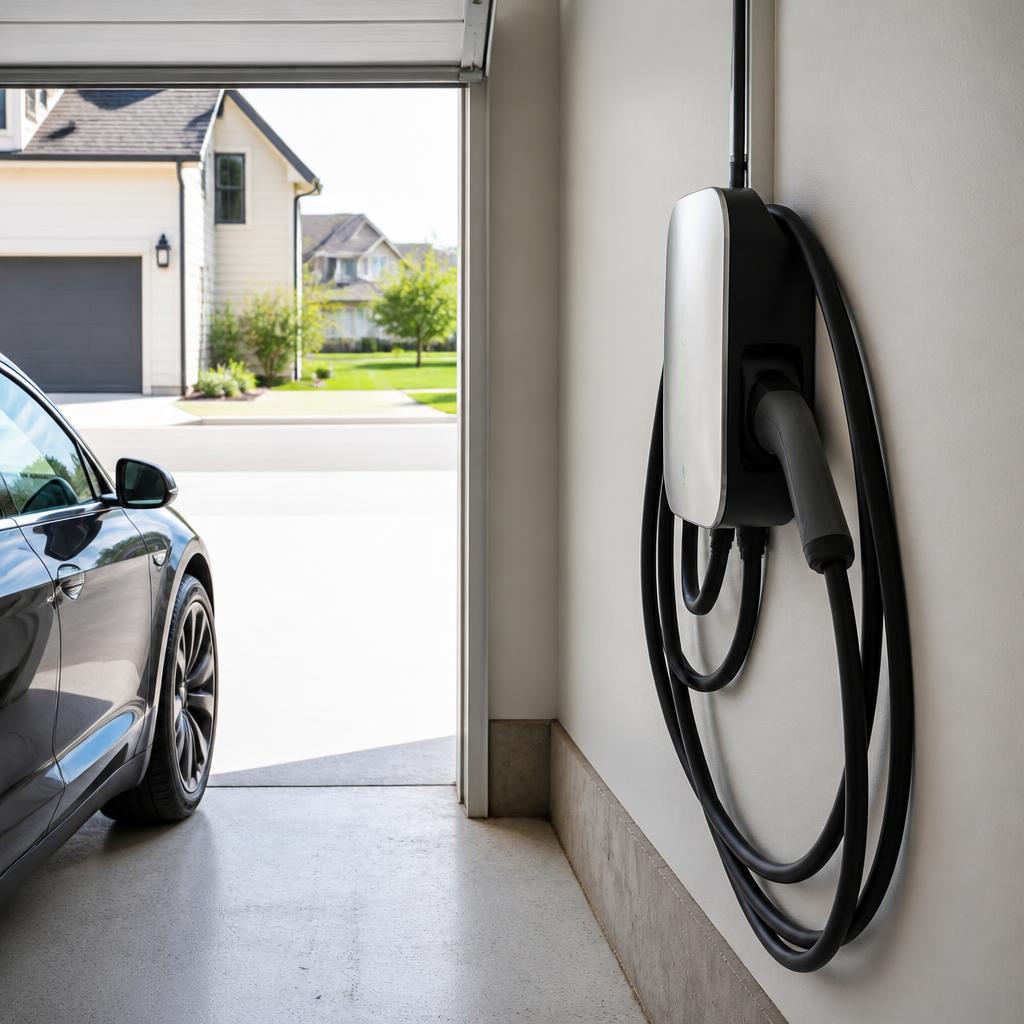
How do EV chargers work?
How do EV chargers work? The charger in your garage is technically EVSE — electric vehicle supply equipment. It does not charge the battery directly. Instead, it safely delivers AC power from your home to the car, communicates with the car to confirm it is safe to start, and the car's onboard charger converts that AC power to DC for the battery. The wall unit is the gatekeeper: it checks the connection, manages the power, and stops the flow if anything goes wrong. That is why a proper install matters — the wall unit is a safety device, not just a socket.
In practice, it is simple: you arrive home, plug the cable into the car, and walk away. The charger starts on your schedule — usually overnight, when electricity is cheapest — and the car is full in the morning. Level 1 charging uses a standard 120V outlet and adds 3–5 miles per hour, which is slow. Level 2 uses a 240V circuit and adds 25–44 miles per hour, which fills a typical daily commute in a few hours. Level 3 is DC fast charging at public stations, not a home product. Our Level 1 vs Level 2 vs Level 3 guide compares the three in full.
What EV charger to install at home?
What EV charger should I install at home? For a first-time owner, the answer is almost always a Level 2 charger, hardwired or plug-in, on a 40A to 60A circuit. Which one depends on your car: a Tesla suits the Tesla Wall Connector with its native NACS plug; a non-Tesla suits a ChargePoint Home Flex, Wallbox, Emporia or Grizzl-E with a J1772 plug. The amperage depends on your panel and your driving: 32A is enough for a normal commute, 48A is better for long daily distances or a large-battery car. A load calculation at the survey confirms what your panel can carry.
Home EV charger setup tips for a first install: choose the charger by your car's connector, not by the brand you have heard of; confirm the panel capacity before you buy anything; decide hardwired or plug-in based on whether you rent or own and whether the charger will live outdoors; and get one all-inclusive quote that covers labour, materials, permit and inspection. A typical Level 2 install in Orlando runs $800–$2,500 including the charger, with simple short-run jobs from around $599. Our best home EV chargers 2026 guide compares the main options.
Where to install an EV charger at home
Where should I install my EV charger at home? Where to install an EV charger is decided by three things: where you park, where the panel is, and where the car's charge port sits. The charger should be on the wall nearest the car's charge port, with the cable reaching comfortably without stretching across a walkway. The shorter the wire run from the panel, the cheaper the install — so a charger on the garage wall next to the panel is the cheapest possible job, and a charger at the far end of a detached garage is the most expensive.
Garage or driveway? A garage install is sheltered, shaded and secure, and it is the default. A driveway or carport install works too, with an outdoor-rated charger, weatherproofing and surge protection — see our outdoor installation guide. Either way, keep the cable on its holster, off the floor, and out of the way of the car. And think about the future: if a second EV is likely, tell the installer at the first survey so the circuit can be designed for power-sharing later.
Will a Level 2 charger hurt my EV battery?
Will a Level 2 charger hurt my EV battery? No — Level 2 charging at 7–11 kW is daily-charge friendly, and it is how your car is designed to be charged at home. What wears batteries is DC fast charging used constantly, and charging to 100% and leaving the car there every day. The habit that protects your battery is simple: charge to 80% for daily driving, and only charge to 100% when you need the full range for a long trip. Most makers suggest 80–90% for daily use, and most cars let you set that limit in the car or the app.
The other battery-friendly habit is scheduling. Charging overnight, when the battery is cool and the grid is quiet, is gentler than charging in the heat of a Florida afternoon. Smart chargers can schedule automatically — set the departure time, and the charger works out when to start. It is one of those features that sounds minor and turns out to matter every single day.
Your first month with home charging
The first month is about building the habit. Plug in every night, even if the battery is not low — a topped-up car is a car you never have to think about. Set the charge limit to 80% and the schedule to overnight. Learn the app: how to start and stop a charge, how to see the energy used, and what the lights mean. And keep the cable tidy — on the holster, off the floor, out of the sun. Within a month, home charging will feel as routine as plugging in your phone, and the public charger will become something you use on road trips, not something you depend on.
If something feels wrong in that first month — the charger trips, the app will not connect, the car charges slowly — do not wait. A new install that is not working properly should be checked under the workmanship guarantee, and most teething problems are a setting or a Wi-Fi issue rather than a fault. Our Wi-Fi troubleshooting guide and tripping-breaker guide cover the first checks, and a call to your installer covers the rest.
Questions Homeowners Ask Us
How do EV chargers work?
The wall unit (EVSE) safely delivers AC power to the car and communicates with it; the car's onboard charger converts AC to DC for the battery. You plug in at home and the car charges overnight on your schedule.
What EV charger should I install at home?
Almost always a Level 2 charger: Tesla Wall Connector for a Tesla, ChargePoint Home Flex, Wallbox, Emporia or Grizzl-E with J1772 for a non-Tesla. A load calculation confirms the amperage your panel supports.
Where should I install my EV charger at home?
On the wall nearest your car's charge port, with the cable reaching comfortably and the shortest practical wire run from the panel. Garage is the default; driveway or carport works with an outdoor-rated charger.
Will a Level 2 charger hurt my EV battery?
No — Level 2 at 7–11 kW is daily-charge friendly. Charge to 80% for daily driving and only to 100% for long trips; constant DC fast charging and constant 100% are what wear batteries.
Ready to Get Your Charger Installed?
Every quote starts with a free on-site assessment and load calculation. Call (407) 555-0134 (placeholder) or visit our contact page to book your survey.
Related services: Residential EV charger installation, Level 2 EV charger installation, Tesla Wall Connector installation.
Related guides: Level 1 vs Level 2 vs Level 3 charging, Best home EV chargers 2026, Will an EV charger raise my electric bill?.
Service areas: Oviedo, Winter Garden — and all areas on our service areas page. Back to the EV charger guides hub.
Where to Put the Charger
Where to install an EV charger at home?
In the garage, on the wall nearest where the car parks and closest to the panel — a short wire run keeps the price down. Driveway and carport installs are common too, with a weatherproof unit.