Charging Two EVs at Home
One charger or two? Power-sharing, dual-port units and the load calculation that decides — for the growing number of two-EV Orlando homes.
Charging two EVs at home is one of the fastest-growing questions in Orlando, and it is easy to see why: the second EV usually arrives a year or two after the first, the garage already has one charger, and the question is whether that is enough. Sometimes it is. Sometimes the right answer is a second charger, a power-sharing pair, or a dual-port unit. And sometimes the panel has the final say. This guide works through the options in the order that matters: your driving, your panel, and then the hardware.
The short version: one charger can serve two EVs if both cars are home overnight and neither needs a fast turnaround — you alternate nights, or you share. Two chargers are better when both cars drive long distances daily, when both need to be full every morning, or when the cars have different connectors. The load calculation decides what your panel can carry, and a power-sharing setup often lets two chargers share one circuit where two separate circuits would need a panel upgrade.
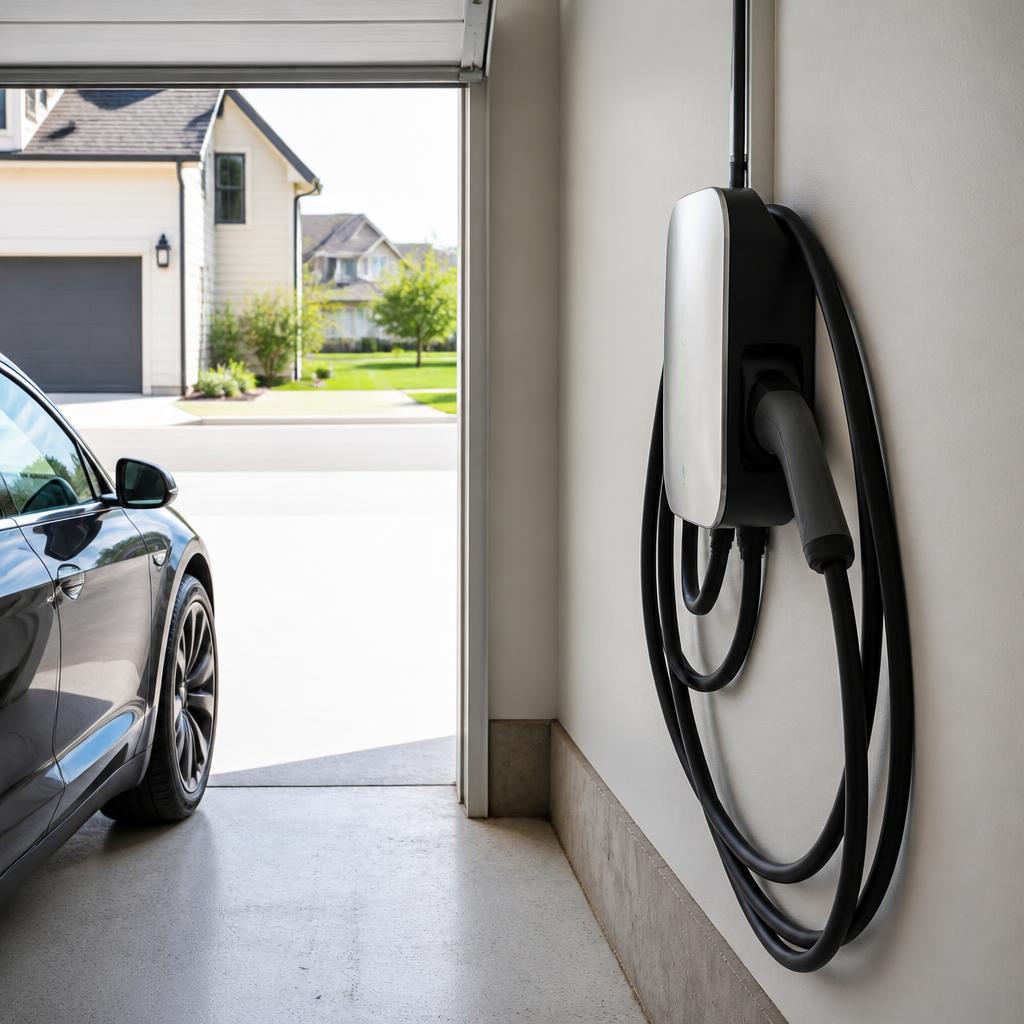
Charging two EVs at home — one charger or two?
Start with your driving, not the hardware. If both cars do a normal commute — 30 to 50 miles a day each — a single Level 2 charger is often enough. A 40A charger adds roughly 30 miles of range per hour, so each car needs only an hour or two a night. You plug in one car when you get home, swap the cable later in the evening, or alternate nights. It is slightly less convenient than two chargers, and it costs nothing extra. Many two-EV households run happily on one charger for years.
Two chargers earn their keep when the driving is heavier. Two long commutes, a car that does rideshare or delivery miles, a household where both cars leave early and arrive late — in those cases, both cars need to charge every night, and sharing one cable becomes a nightly chore that someone forgets. Two chargers also matter when the cars have different connectors: a Tesla and a non-Tesla, for example, may each want their native plug rather than an adapter every night. The convenience is real, and for a household that will own two EVs for years, it is worth pricing properly.
Power-sharing pairs: two chargers, one circuit
Power-sharing is the clever middle option, and it is the one most two-EV households end up choosing. Two chargers — for example, two Tesla Wall Connectors — are installed on a single circuit and share the available power between them. When only one car is charging, it gets the full power. When both are charging, the power splits. The total never exceeds what the circuit can carry, so the panel sees one load, not two — and the install needs one circuit, one breaker and one wire run, not two.
Power-sharing is also the answer when the panel is tight. A 100-amp panel that cannot carry two separate 40A circuits can often carry one shared 60A circuit with two power-sharing chargers, especially when combined with a load management device that throttles charging when the house peaks. It is code-compliant, inspector-approved, and standard practice. Tell your installer at the first survey that a second EV is coming — even if it is a year away — and the first install can be designed for it, with the circuit and the mounting ready for the second unit.
Dual-port chargers and two separate circuits
A dual-port charger is a single wall unit with two cables, designed to charge two cars at once. It is a neat solution for a two-car garage with limited wall space, and it suits workplaces and multi-unit properties as well as homes. The trade-off is that the two ports share the unit's total power, so each car charges more slowly when both are plugged in — the same principle as power-sharing, in a single box. A dual-port unit is worth considering when wall space is tight or when you want one device to manage rather than two.
Two separate circuits are the most capable option and the most expensive: each car gets its own full-speed charger, independent of the other. It needs a panel that can carry both circuits, which usually means a 200-amp service or a load management setup, and it needs two wire runs. For most homes it is more than is needed — but for two heavy drivers, or a household with an electric truck and a long-range car, it is the right answer. A load calculation tells you which options your panel actually supports, and that is the step that should come before any hardware decision.
What the load calculation says about two EVs
Every two-EV plan starts with a load calculation under NEC Article 220, because two chargers are two continuous loads and the panel must carry them together with the rest of the house. On a 200-amp panel, two Level 2 chargers are usually straightforward. On a 100-amp or 125-amp panel, the calculation is tighter, and the answer is often a lower amperage for each charger, a power-sharing pair, or a load management device — in that order, before a panel upgrade is considered. A panel upgrade adds roughly $2,000–$5,000, so it is worth exploring the alternatives first.
The other factor is timing. Two EVs charging overnight do not need to charge at the same time: smart chargers can be scheduled so one charges in the early evening and the other later at night, spreading the load. That scheduling is free, it works with any charger that has an app, and it is often enough on its own. Our EV charger load management guide explains the devices that automate this when scheduling alone is not enough.
Planning for the second EV before it arrives
If you are installing your first charger and a second EV is likely within a few years, say so at the survey. The cheapest time to prepare for a second charger is during the first install: a larger conduit, a circuit sized for power-sharing, a second mounting point, and a load calculation that already accounts for the second car. Retrofitting those later costs more than including them now, and in some homes the first install's wire route is the only practical route — running a second one later means opening walls twice.
A typical Level 2 home install in Orlando runs $800–$2,500 including the charger, with simple short-run jobs from around $599. A two-charger install costs more, but not twice as much — the survey, the permit and the panel work are shared, and a power-sharing pair needs only one circuit. Get one quote for the first charger and one for the pair, and you will see the difference clearly. And if the second EV is still a distant plan, install the first charger with a power-sharing-capable unit and leave the second for later: the option stays open at no extra cost today.
Questions Homeowners Ask Us
Charging two EVs at home — one charger or two?
One charger can serve two EVs if both are home overnight and neither needs a fast turnaround — alternate nights or share the cable. Two chargers suit two long commutes, two early departures, or cars with different connectors.
What is power-sharing for two EV chargers?
Two chargers on one circuit share the available power: one car charging gets full power, two cars charging split it. The panel sees one load, so it often avoids a panel upgrade on a 100-amp service.
Can a 100-amp panel handle two EV chargers?
Sometimes, with power-sharing and load management — a load calculation decides. Two separate full-speed circuits usually need a 200-amp service; a shared circuit with load management often fits a 100-amp panel.
Ready to Get Your Charger Installed?
Every quote starts with a free on-site assessment and load calculation. Call (407) 555-0134 (placeholder) or visit our contact page to book your survey.
Related services: Level 2 EV charger installation, Tesla Wall Connector installation, Electrical panel upgrade.
Related guides: Tesla Wall Connector vs ChargePoint, EV charger load management guide, Level 1 vs Level 2 vs Level 3 charging.
Service areas: Oviedo, Lake Mary — and all areas on our service areas page. Back to the EV charger guides hub.